Pebbledash is one of the most common exterior finishes you'll see across Greater Manchester — semi-detached houses in Oldham, terraces in Rochdale, bungalows in Bury — and it's also one of the most commonly cleaned incorrectly. Cleaning pebbledash render is not the same as cleaning a smooth painted wall or a concrete driveway, and the wrong approach can cause damage that costs considerably more to fix than the original clean would have. This guide covers what pebbledash actually is, what grows on it, and the only method that cleans it safely.
If you've noticed your pebbledash looking green, streaked with black, or patchy with orange and brown staining, you're not imagining it getting worse year on year. The North West's damp climate, persistent cloud cover, and mild winters create near-perfect conditions for biological growth on exterior surfaces. Understanding why that happens — and how to deal with it properly — makes the difference between a surface that looks clean for a few years and one that starts shedding stones.
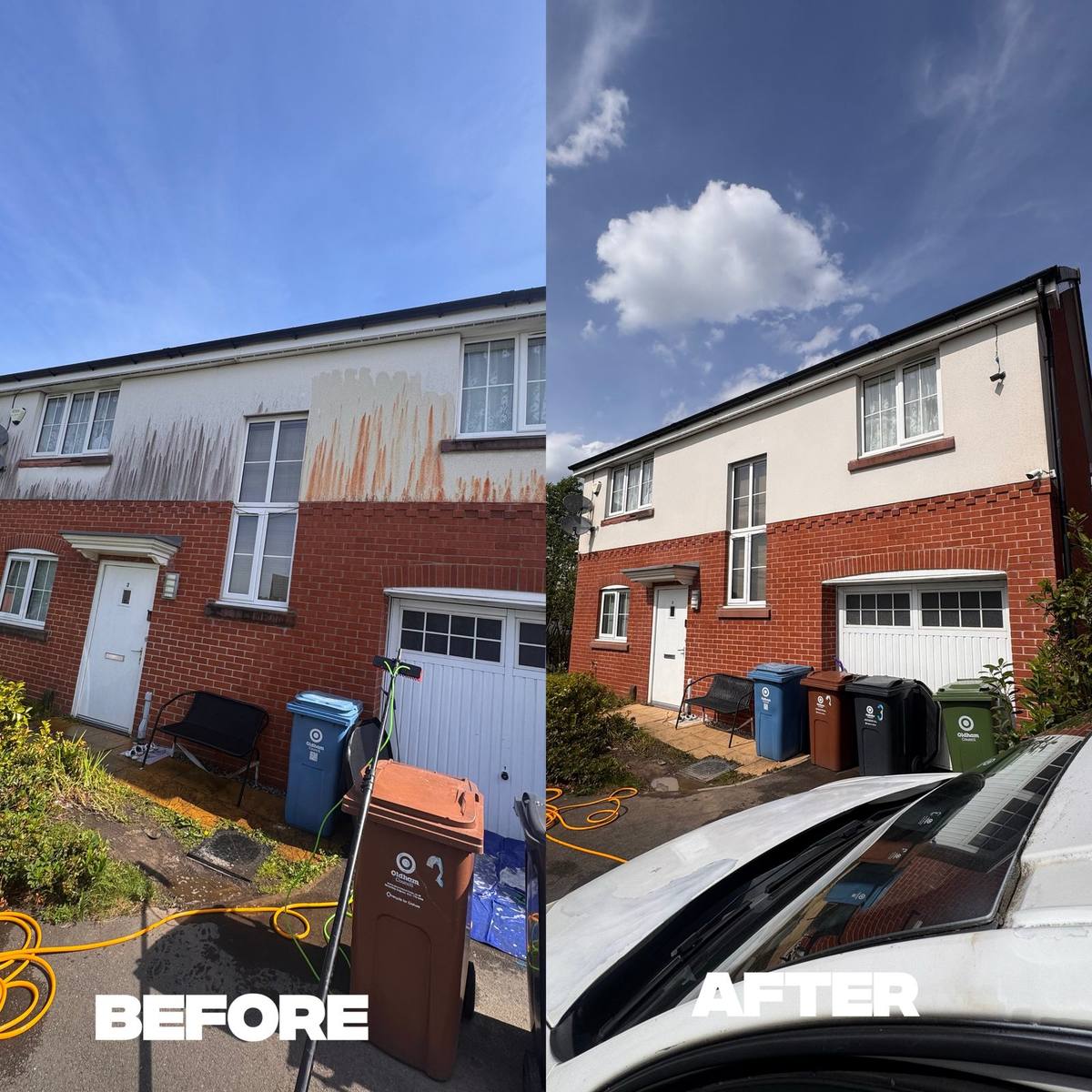
Pebbledash render cleaned using low-pressure softwash — no stones dislodged, no surface damage.
Quick answer: Pebbledash render should be cleaned using a low-pressure softwash with a diluted sodium hypochlorite solution, not a high-pressure jet washer. High pressure dislodges the stone aggregate and cracks the render beneath. A biocidal wash kills algae and moss at the root, leaving results that last far longer than blasting alone.
What Is Pebbledash and Why Is It So Easy to Damage?
Pebbledash is a two-stage render system. A base coat of sand and cement is applied to the wall, and while it's still wet, small stones or gravel — sometimes mixed with shell — are thrown at the surface so they embed into the render. Once cured, it forms a hard, textured finish that was popular in UK housing construction from the early twentieth century right through to the 1980s. Much of the housing stock across Oldham, Rochdale, and the surrounding towns is finished this way.
The problem is that the bond holding each individual stone into the render base weakens over time. UV exposure, decades of freeze-thaw cycles, and general weathering all take their toll. Greater Manchester averages over 130 days of frost a year in some areas, and the repeated expansion and contraction of moisture trapped in the render is hard on that stone-to-base bond. By the time a property is 40 or 50 years old, some of that bond may already be compromised in places, even if it isn't obviously visible from the ground.
This matters enormously when it comes to choosing a cleaning method. A surface where the aggregate is still firmly bonded is very different to one where the stones are already beginning to loosen. Any cleaning approach that introduces significant mechanical force risks accelerating that deterioration, or tearing stones clean off — which then leaves the render beneath exposed and vulnerable to water ingress.
What's Actually Growing on Your Pebbledash?
The green colouration most people notice first is algae — typically green algae that thrives in damp, shaded conditions and spreads rapidly across porous or textured surfaces. The black streaks and patches are usually lichen, which is a more tenacious organism: a symbiotic combination of algae and fungi that actually roots into the surface rather than sitting on top of it. Orange and red streaking is often caused by iron-rich algae or, in some cases, rust bleeding from metal fixings such as soil pipe brackets or window reveals. Moss tends to accumulate in deeper recesses and around window surrounds where moisture lingers.
Pebbledash is particularly hospitable to all of these because its rough, uneven texture traps moisture and organic debris — dust, pollen, leaf particles — that feeds biological growth. A smooth render sheds rain and dries faster. Pebbledash holds it. North-facing elevations are the worst affected because they rarely get enough direct sun to dry fully between rain events, and in a Greater Manchester winter, that can mean a wall stays damp for weeks at a time.
The depth of contamination matters too. Surface algae that's been there for a season or two will respond readily to a chemical treatment. Black lichen that's been colonising a wall for a decade has physically bonded with the render surface and needs a stronger biocidal dwell time and, in some cases, a follow-up application before it fully dies back. Be realistic about this: a heavily lichenated wall will improve significantly after a professional softwash, but it may take several weeks for the dead growth to fully break down and wash away in the rain, rather than looking pristine the same afternoon.
Why a Jet Washer Will Make Things Worse
This is the part of the conversation that's worth being direct about. A standard petrol or electric pressure washer — even a domestic one — operates at pressures that are simply incompatible with pebbledash. The force needed to blast biological growth off a textured surface is more than enough to dislodge individual stones, erode the render base beneath them, and drive water into the wall cavity behind. You can do visible damage in minutes.
The signs that a property has already been pressure-washed incorrectly are fairly obvious once you know what to look for: patches where stones are missing or thinning, areas where the surface looks scoured and the render base is exposed, and tide marks where the jet has been held too long in one spot. Sometimes you'll see cracking that follows the pattern of a fan jet. If water has been forced into the wall, damp patches may appear on the inner leaf — which is a more serious and expensive problem than dirty render ever was.
Some people try to manage the risk by using a lower pressure setting or holding the lance further back, but this is still guesswork on a surface that may already have weakened bonds in places you can't see. The fundamental issue is that mechanical pressure is the wrong tool for this job. The right approach removes biological contamination chemically, not forcibly — which is what softwashing is designed to do.
The Right Method: Low-Pressure Softwashing Explained
Softwashing uses a diluted sodium hypochlorite solution applied at very low pressure — comparable to a garden hose rather than a jet washer — to kill biological growth at a chemical level. The process for cleaning pebbledash render follows a consistent sequence. The surrounding area — plants, borders, paths, drainage — is pre-wetted and protected. The biocidal solution is then applied evenly across the render surface and left to dwell. Dwell time varies depending on contamination severity, but for established algae and lichen it's typically a minimum of 20 to 30 minutes, sometimes longer.
During the dwell period, the sodium hypochlorite oxidises and kills the biological growth, breaking down cell walls at a molecular level. It doesn't just bleach the surface — it kills the organism, including its root structures in the case of lichen. After dwell, the surface is rinsed at low pressure to remove the residue. Because the pressure used throughout is low, there's no mechanical stress on the aggregate or the render base. The chemical is doing the cleaning, not the water force.
Results vary depending on how long the growth has been established and what type of organism you're dealing with. Algae typically shows a clear improvement the same day. Lichen may appear lighter immediately but will continue to break down over the following weeks as the dead growth weathers off. This is normal and expected — it's not the treatment failing, it's the process completing. For more on how softwashing works across different surfaces, the softwashing service page covers the method in detail.
Never apply a sodium hypochlorite solution to dry render on a warm day. Pre-wetting the surface first slows absorption, gives you more control over the dwell, and reduces the risk of streaking where the solution dries unevenly before it's had time to work. This is one of the most common mistakes in DIY biocide applications.
Can You DIY Softwash Pebbledash Render?
Honest answer: in theory, yes. In practice, safely, for most homeowners, probably not. Sodium hypochlorite at the concentrations needed to treat lichen and established algae — typically a 3 to 5 percent dilution of a professional-grade stock solution — is a hazardous substance. It causes chemical burns to skin and eyes, releases chlorine gas if mixed incorrectly or used in poorly ventilated spaces, and will bleach clothing, timber, and metalwork on contact. Correct PPE means chemical-resistant gloves, eye protection, and appropriate respiratory protection when mixing or applying.
Beyond the chemical handling, there's the access question. Most pebbledash properties in Greater Manchester are at least two storeys, with gabled ends that extend well above the first-floor roofline. Applying a biocidal treatment to a high gable from a ladder, while managing a spray lance and controlling runoff, involves real height risk. Professional operatives work with appropriate access equipment, safely and with insurance in place.
There are also practical limits to what DIY application achieves. Getting even coverage across a textured surface at low pressure requires the right equipment — a dedicated softwash pump and appropriate nozzle, not a garden sprayer or a repurposed pressure washer on low. Runoff that isn't controlled can damage lawns and planted borders, and failure to rinse properly can leave a white residue on the render. For a garden wall or a single-storey outbuilding, DIY softwashing is achievable with care. For a full house elevation, the risk-to-reward calculation shifts considerably.
When to Call a Professional Instead of Doing It Yourself
There are certain scenarios where professional help is clearly the right call, and it's worth being specific about them. Any wall above a single storey falls into this category — not because the method is complicated, but because the access is genuinely hazardous without the right equipment. The same applies to large surface areas where even coverage matters and fatigue becomes a factor.
If you can see cracking in the render, loose or missing stones, or any sign that the substrate is already compromised, cleaning should not happen until those issues are assessed. Applying a biocidal solution to a cracked or failing render risks driving moisture into the wall, and if a professional pressure wash has previously been carried out, there may be underlying damage that isn't immediately obvious. Getting a professional to assess the surface before any treatment is the sensible step.
Black lichen that has been present for many years often needs a two-stage approach — an initial treatment followed by a second application after the first has had time to work — and correctly judging dwell times and solution concentrations for heavily contaminated surfaces takes experience. C&C Precision Precision Washing carry out render cleaning across Greater Manchester and can assess from photos whether a surface is suitable for treatment and what approach is appropriate. It takes a few minutes to get a quote via WhatsApp without needing anyone to visit first.
Practical Takeaways: What to Do Before, During, and After
Before any cleaning takes place — whether professional or DIY — walk the elevation and look carefully for cracks, loose stones, and areas where the render sounds hollow when tapped. Pay attention around window reveals, soil pipe fixings, and anywhere metal has been in contact with the render, as these are common points of failure. Flag anything you find to your contractor, or address repairs before proceeding.
If a biocidal treatment is being applied, protect plants and borders. Pre-wet them thoroughly before the solution goes on, sheet off anything particularly vulnerable, and rinse again afterwards. Check that drainage gullies are clear — you don't want concentrated runoff sitting in a blocked gully. After the treatment, resist the urge to judge the result on the same day. Allow at least two to four weeks, ideally in wet weather, for dead growth to break down and wash away. The wall will continue to improve over that period.
In the North West's climate, biological growth on pebbledash is effectively a maintenance task rather than a one-off problem. A properly applied softwash treatment in good conditions should keep a surface clean for two to four years depending on aspect and surrounding tree cover. North-facing walls in shaded spots will see regrowth return faster. A follow-up biocidal spray every couple of years is far cheaper than a full clean each time and keeps growth from re-establishing deeply. If you're also dealing with contaminated hard surfaces around the property, the guides on driveway cleaning and patio cleaning cover what's involved for those surfaces specifically.
Frequently asked questions
Can I use a pressure washer on pebbledash render?
Not at standard pressure, no. The force is enough to pop individual stones off the surface and erode the render beneath, which can lead to damp problems and expensive repairs. If you want to use water-based cleaning at all, it needs to be at very low pressure — closer to a garden hose than a jet washer — combined with a biocidal chemical treatment that does the actual work.
How long does softwashing pebbledash render last?
A proper softwash treatment typically keeps pebbledash looking clean for two to four years, depending on the property's aspect and local tree cover. North-facing walls in shaded spots will see biological growth return faster than south-facing ones. A light follow-up biocidal spray every couple of years is far cheaper than a full clean each time.
Will softwashing damage my plants or lawn?
Sodium hypochlorite can scorch plants and harm lawn grass if it's not handled correctly. A professional will pre-wet surrounding vegetation, control where the solution is applied, and neutralise runoff before it reaches borders or drainage. If you're attempting this yourself, sheeting off plants and diluting carefully are non-negotiable steps.
How much does it cost to have pebbledash render cleaned professionally in Greater Manchester?
Cost varies based on the size of the property, how much of the render needs treating, and how severe the contamination is. The quickest way to get an accurate figure is to send a few photos showing the affected areas — we can usually turn a quote around the same day via WhatsApp without needing a site visit first.
Got pebbledash that needs sorting in Greater Manchester?
Send a couple of photos over WhatsApp and we'll come back with a straightforward price — usually the same day.