If you've noticed a green or dark brown fuzz spreading across your roof tiles, you're not alone. Moss on roof slopes is one of the most common issues we're called out for across Greater Manchester, and it's something that catches a lot of homeowners off guard — mainly because it tends to build up quietly over several years before anyone really pays attention to it. By the time it's clearly visible from the street, it's usually been there for a while.
This guide covers what roof moss actually is, what it does (and doesn't) do to your tiles, how to assess whether yours needs professional attention, and what the correct treatment looks like. There's no scare-mongering here — just straightforward information so you can make a sensible decision about whether to act now or keep an eye on it.
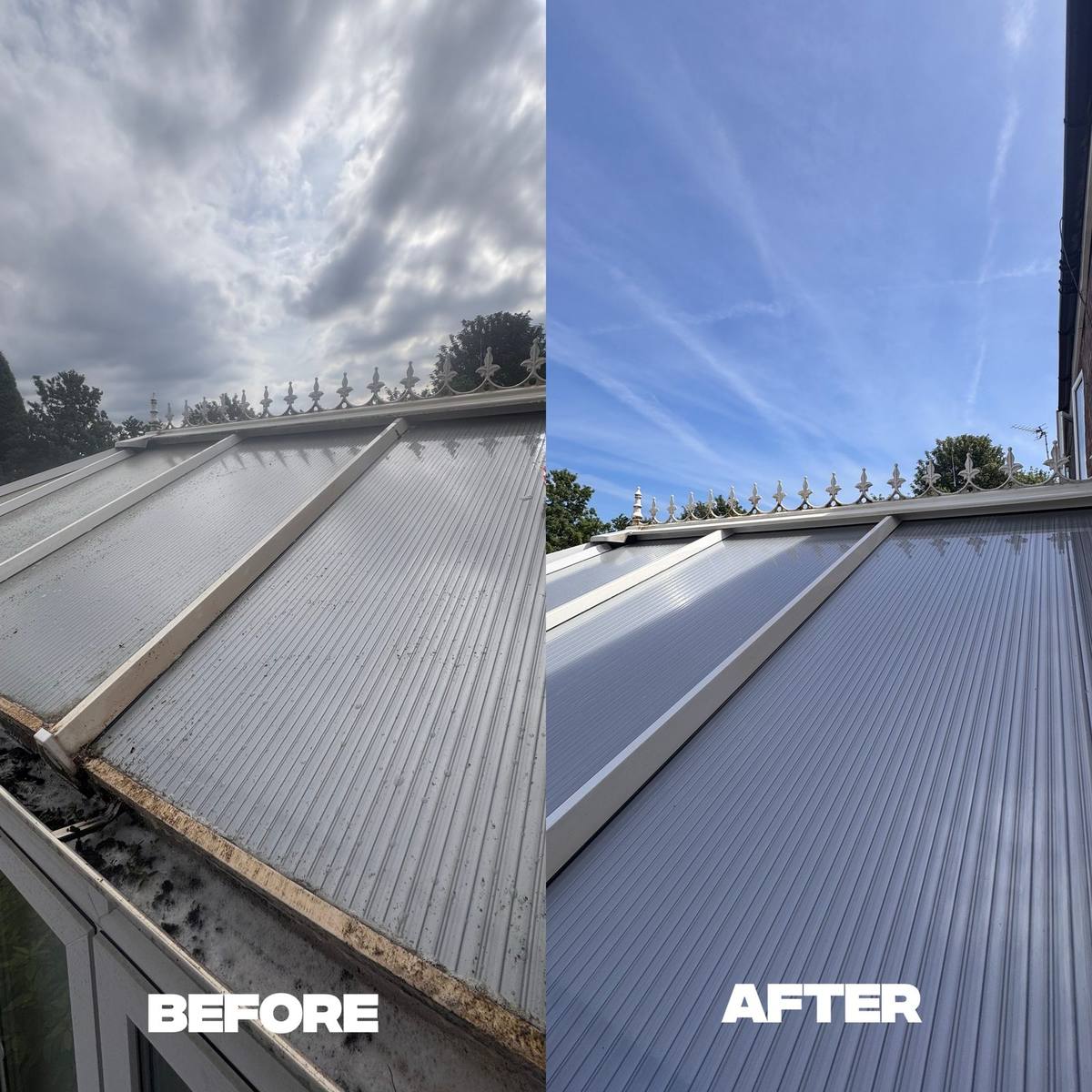
Before and after: moss and gutter debris cleared from a conservatory roof by C&C Precision.
Quick answer: Moss on your roof is worth taking seriously. Left untreated, it retains moisture against your tiles, accelerating freeze-thaw damage, blocking gutters, and slowly degrading mortar. It won't cause overnight collapse, but over several years it can shorten your roof's lifespan and lead to expensive repairs.
What Actually Is Roof Moss and Why Does It Grow?
Moss is a non-vascular plant — it has no roots in the conventional sense, but it anchors itself to surfaces using thread-like structures called rhizoids. Unlike most plants, it doesn't need soil. It needs moisture, a rough surface to grip, and low direct sunlight. Roof tiles, particularly the textured concrete or clay varieties common on housing stock across Oldham, Rochdale and the wider North West, give moss almost everything it wants.
North-facing roof slopes are significantly worse for moss growth because they dry out far more slowly after rain. A south-facing pitch in a dry summer might bake off moisture within a few hours; the north face of the same house can stay damp for days. Add in the Greater Manchester climate — persistent drizzle, overcast skies for long stretches, and relatively mild winters that rarely give a prolonged hard freeze — and you have conditions that encourage moss to establish and spread year-round in a way that simply doesn't happen in drier parts of the country.
Trees also play a role. Shaded roofs, or those that catch falling leaves and debris, stay damper and accumulate organic matter that moss uses as a nutrient base. If you have mature trees close to your property, expect the problem to return more quickly after treatment than on an open, exposed roof.
The Real Damage Moss Can Do Over Time
The most significant mechanism of damage is moisture retention. Moss acts like a sponge, holding water against the tile surface long after rain has stopped. During cold snaps — and we get enough of them in Greater Manchester, even if prolonged freezing is less common than further north — that trapped moisture can freeze and expand, working into any existing micro-cracks in the tile. Over several winters, this freeze-thaw cycle gradually degrades the tile, making it brittle and more prone to cracking or spalling.
The rhizoids that anchor moss to the tile surface cause a second type of damage. As moss colonies mature and grow thicker, these structures work their way into the small gaps between tiles and along the edges of laps. On older roofs where the original bedding mortar has already started to soften, this physical intrusion can gradually lift and loosen tiles — not dramatically, but enough to allow wind and rain to do further damage. A tile that's slightly lifted is far more likely to shift in a storm than one sitting flat.
The third problem is what ends up in your gutters. Established moss growth sheds debris — dead material, loosened spores, small fragments — all of which washes down into the gutter channel. Over time this contributes to blockages, and blocked gutters overflow. That overflow runs down the fascia boards and the wall below, which is how you end up with damp patches on external walls, stained render, and rotting timber — problems that cost considerably more to fix than the original roof clean would have.
What It Won't Do (Keeping It Honest)
A light scattering of moss on an otherwise sound roof is not a crisis. If your tiles are in reasonable condition, the coverage is patchy rather than widespread, and your gutters are clear, there's no reason to panic. Moss grows slowly, and a roof that's been showing early signs for a year or two is not on the verge of structural failure. Anyone who tells you otherwise is overselling the urgency.
It's also worth being clear that moss itself doesn't cause leaks directly — it's the secondary effects over an extended period that create the conditions for problems. A roof with a thin layer of moss on a few tiles and no other issues is far lower priority than one where the moss is thick, the gutters are overflowing, and you can see displaced tiles from the street. Context matters, and a sensible professional will tell you honestly where your roof sits on that spectrum rather than quoting a job that isn't really needed yet.
How to Tell Whether Your Moss Problem Is Minor or Serious
You can make a reasonable first assessment from the ground. Stand back far enough to see the full roof slope and look at what percentage of the visible tiles are covered. A rough patch in one corner or along the ridge line is a different situation from a roof where the majority of tiles have a visible green or dark covering. If you have a pair of binoculars, use them — you'll be able to see whether any tiles look lifted, cracked, or out of alignment, which are separate concerns that need a roofer's eye regardless of the moss.
Check your gutters while you're at it. If they're overflowing during rain, or if you can see vegetation and debris visible above the gutter line from the ground, that's a sign the roof is shedding significant organic material. Dark staining on the render or brickwork below the gutter line tells the same story. Both indicate the moss problem has been established long enough to start causing downstream effects.
One practical note: take photos. A photo taken on a clear day from a sensible angle gives you a record to compare against in future, and it's exactly what a cleaning company will ask you for when working out what's involved. Established, thick moss that's been there for years has a different texture and colour to recent growth — newer moss tends to be a brighter green, while older, denser colonies are darker, more matted, and often mixed with lichen.
Should You Pressure Wash Moss Off a Roof? (Probably Not)
High-pressure washing is the wrong tool for a tiled roof in most cases. The pressure needed to blast off established moss is enough to dislodge the granule surface on concrete tiles, strip the surface treatment from older clay tiles, and force water up under the laps — exactly where you don't want water going. On a roof where the tiles are already aged or slightly fragile, the physical impact of pressure washing can cause cracking that wasn't there before you started. You'd be solving a slow-burn problem by creating a faster one.
The correct approach for moss on roof surfaces is softwashing — applying a diluted sodium hypochlorite solution with a low-pressure applicator and allowing it to dwell on the surface. The biocide kills the moss, lichen and algae at the biological level, breaking down the cell structure rather than just removing the visible growth. What's left dries out and gradually weathers off naturally over the following weeks. Because the spores themselves are killed rather than just displaced, regrowth is considerably slower than after a physical scrape or pressure wash. It's a less dramatic result to watch, but a much more effective treatment.
After any softwash roof treatment, expect the roof to look a little worse before it looks better. Dead moss turns brown and starts to shed over the first few weeks. This is normal — it means the treatment has worked. The roof should look noticeably cleaner within six to eight weeks as the dead material weathers off.
When to Call a Professional Roof Cleaning Company
The clearest signals are height and access. Working at roof level on anything above a single-storey extension is not a job for a domestic ladder and a Saturday afternoon. A fall from a roof causes serious injury, and no amount of money saved on a cleaning quote is worth that risk. Professional roof cleaning companies use proper access equipment — scaffolding, cherry pickers, or roof ladders rated for the purpose — and carry public liability insurance that covers the work. That insurance matters if anything goes wrong.
Beyond the safety question, significant moss coverage, older tile types such as handmade clay or reclaimed slates, and roofs with visible tile displacement are all situations where an untrained person is likely to cause more damage than they prevent. If you're not confident assessing what you're dealing with, or if the coverage is more than a small isolated patch, a professional assessment is sensible. The cost of a quote — often free — is trivial compared to the cost of a cracked tile, a damaged felt underlayer, or a trip to A&E.
For homeowners across Greater Manchester, C&C Precision handles roof cleaning and moss removal using softwash methods throughout Oldham, Rochdale, Bury, Bolton, Tameside, Stockport and surrounding areas. A few photos sent over WhatsApp is usually enough to give you a same-day quote with no obligation attached.
What to Do Next: A Practical Checklist
Start from the ground. On a dry day, photograph each elevation of your roof — front, back, and both sides if accessible. Get far enough back to capture the full slope. Note which faces look worst; typically it will be the north or north-east-facing pitch. While you're outside, check the gutters for overflow staining on the wall below and look for any debris visible above the gutter line. If you have a flat-roof extension or a conservatory roof, check those separately — moss and algae behave differently on flat surfaces.
If what you're seeing is patchy and the gutters look clear, you may have time to monitor the situation and get a quote at your convenience. If the coverage is significant, you're seeing gutter overflow damage, or you can spot displaced tiles from the ground, it's worth getting a professional eye on it before winter. Freeze-thaw damage on an already compromised tile doesn't announce itself — it just means an unexpected repair bill in January.
The easiest first step is to send your photos over WhatsApp for a no-obligation quote. No site visit required, no sales call, just a straightforward price based on what we can see. If the honest answer is that your roof doesn't need work yet, we'll say so — the same way we would for a patio or driveway job that isn't quite at the stage of needing professional attention.
Frequently asked questions
Does moss on a roof void home insurance?
It depends on your policy, but many insurers include a clause about maintaining your property in reasonable condition. If a claim arises and an assessor determines that long-term neglected moss contributed to the damage — for example water ingress from a cracked tile — they may reduce or reject the payout. It's worth checking your policy wording.
How often does a roof need to be cleaned for moss?
In Greater Manchester's damp climate, most roofs benefit from a professional clean every three to five years. Properties with significant shade from trees or a predominantly north-facing pitch may need attention more frequently. A softwash treatment kills the spores and slows regrowth considerably compared to just brushing the moss off.
Can I remove moss from my roof myself?
You can buy moss killer treatments and apply them from a ladder, but working at height is a serious risk and most domestic ladders don't give safe access to a full roof slope. Brushing moss off dry without treating the underlying spores also means it grows back quickly. For anything beyond a small single-storey section, a professional with the right equipment and insurance is the safer call.
How much does roof moss removal cost in Greater Manchester?
Price depends on the size of your roof, the pitch, access difficulty, and how heavily covered it is. The fastest way to get an accurate figure is to send a few photos over WhatsApp — we can usually give a quote the same day without needing to visit first. There's no obligation and no sales pitch.
Got moss building up on your roof?
Send us a photo on WhatsApp and we'll give you a straight, no-fuss quote — usually same day.