If you've noticed your driveway turning green or black over the past winter, you're not imagining it getting worse faster than it used to. Salford sits in one of the wetter parts of an already wet region, and that persistent damp is the main reason surfaces lose their colour and get slippery long before they're old enough to need replacing. Whether you're searching for driveway cleaning Salford because you've got a block paving drive that's been ignored for a few years, or a concrete apron that's developed a stubborn black crust, the approach matters as much as the machinery.
This guide covers what actually causes driveways in this part of Greater Manchester to deteriorate so quickly, how different surface types should be cleaned, what it costs and what happens on the day. It's written to give you enough information to make a sensible decision — whether that's hiring someone or having a go yourself.
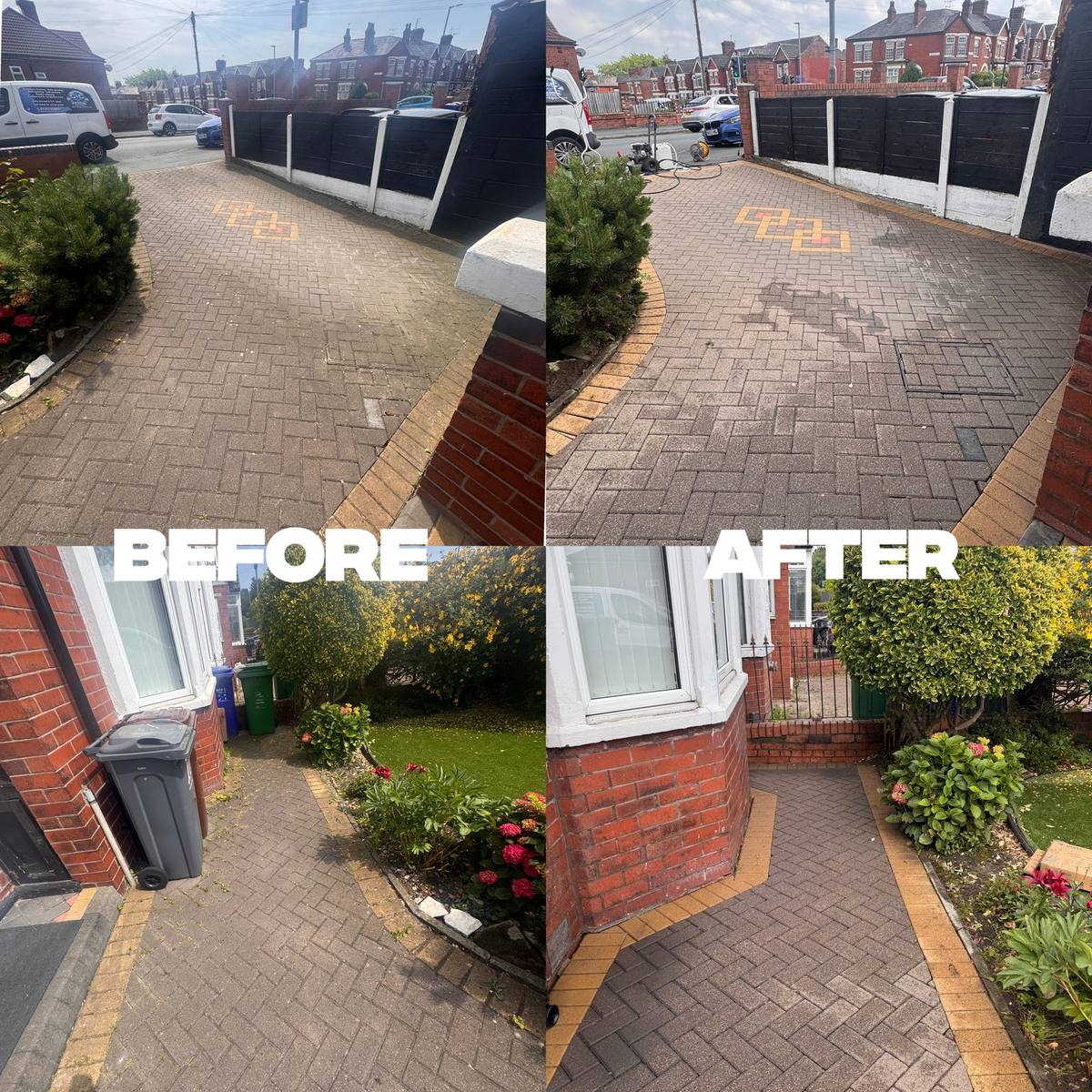
Before and after: a wide concrete driveway after a full C&C Precision clean.
Quick answer: Professional driveway cleaning in Salford typically costs £80–£250 depending on size and surface type. A specialist uses a rotary surface cleaner and pre-treatment to remove algae, moss and staining without damaging the surface. Most driveways take two to four hours and are noticeably transformed the same day.
Why Salford Driveways Get Dirty So Quickly
Greater Manchester averages around 800mm of rainfall a year, and Salford's urban density means surfaces stay damp for longer than they would somewhere with more open airflow. Add short winter days, low sun angles that rarely dry out north-facing drives, and you have near-perfect conditions for algae and moss to colonise any textured outdoor surface. Block paving joints, the rough face of exposed aggregate concrete and the small voids in tarmac all trap moisture and organic debris — the raw material algae needs to spread.
Black spot — the dark, almost tar-like staining you sometimes see on block paving and concrete — is lichen rather than simple algae. It anchors itself into the surface with tiny root structures and resists ordinary washing entirely. It's extremely common on Salford and Greater Manchester driveways because lichen thrives in cool, humid air with limited direct sunlight. Chemical pre-treatment, not just water pressure, is what breaks it down. Worth understanding that going in, because it shapes what kind of clean your driveway actually needs.
Pollution plays a part too. Salford's proximity to the M602, the A57 and the city centre means traffic particulates settle on surfaces constantly. These dark deposits bond with the biological growth and make driveways look far older than they are. It's one reason a professional clean can produce results that look almost shocking — the surface underneath is often in genuinely good condition.
Block Paving, Concrete or Tarmac — Does the Surface Type Matter?
It does, quite significantly. The three surfaces you'll find on most Salford properties each respond differently to pressure and chemicals, so a one-size approach tends to either underperform or cause damage. Driveway cleaning done properly starts with identifying what you're working with before any equipment is switched on.
Block paving is the most common type on residential properties across Salford. It's porous, the individual blocks can be dislodged by misdirected pressure, and the kiln-dried sand in the joints is vulnerable to being washed out if the operator isn't careful. A rotary surface cleaner set at the right pressure, combined with a pre-treatment dwell stage, gives a consistent clean without lifting blocks or gutting the joints unnecessarily. Concrete is more forgiving of higher pressures but still benefits from pre-treatment to deal with black spot. A rotary surface cleaner is still the right tool — a direct lance leaves visible stripes and can etch softer concrete. Tarmac is the most delicate of the three. It softens slightly under heat in summer and the binder can be disturbed by excessive pressure, so a lower operating pressure and wider fan is the sensible approach.
Stone flags and natural sandstone behave differently again — they're absorbent and can be damaged by aggressive chemicals or high heat. If you have a mixed surface driveway, that needs to be factored into the method used. The same logic applies if your driveway borders rendered walls or brick edging, since overspray from the wrong chemical can cause discolouration to adjacent surfaces.
What Driveway Cleaning in Salford Actually Costs
Pricing for driveway cleaning Salford tends to depend on three things: the size of the driveway, the surface type and the level of biological growth. Block paving cleaning starts from around £3.50 per square metre for a straightforward clean. Where black spot, heavy lichen or significant moss is present and a chemical pre-treatment is needed, that typically moves to around £4.25 per square metre. A full restoration including re-sanding eroded joints is around £5.50 per square metre. If the joints are intact and you only need re-sanding done as a separate job, that's around £2.00 per square metre.
For a typical semi-detached in Salford with a single-width block paving drive of around 30–40 square metres, you're looking at roughly £100–£170 depending on condition. Larger driveways on detached properties, or surfaces that haven't been touched in five or more years, will cost more — not because of arbitrary pricing, but because they genuinely take longer and use more chemical. There are no hidden add-ons after the work starts.
The fastest way to get an accurate quote is to send two or three photos on WhatsApp — one showing the full driveway from the front, one close up of the worst area of staining, and one of any obvious joint erosion if it's block paving. Most quotes come back the same day with a fixed price, not a range.
Sealing is a separate cost if you want it done at the same visit. It's worth reading the separate guide on how long driveway sealing lasts in Greater Manchester before deciding — sealing isn't always necessary, and on some surfaces it can cause problems if applied to a driveway that's already had a previous coat.
The Cleaning Process Step by Step
The job starts with a pre-treatment rather than immediately using the pressure washer. A biocide or surfactant solution is applied to the surface and left to dwell — typically 15 to 30 minutes depending on the product and the level of growth. This breaks down the cellular structure of algae and lichen at a chemical level, which means the pressure washing stage removes the residue cleanly rather than just redistributing it. Skipping this step is why DIY jobs sometimes look good for a few weeks and then go green again faster than before — the spores haven't been killed, just shifted.
Once the dwell time is complete, a rotary surface cleaner is worked across the whole surface methodically, overlapping passes slightly to avoid visible lines. Edge detailing is done with a lance on a low setting where the rotary head can't reach — along walls, around drains and in corners. A thorough rinse-down finishes the main clean. What's left on the surface should be biologically dead even if some older staining has lightened rather than fully disappeared. On weathered concrete and older block paving, deep stains from oil or iron sometimes lighten significantly without vanishing entirely — that's worth knowing beforehand rather than after.
If block paving joints need re-sanding, that happens once the surface is fully dry — usually at a follow-up visit the next day, or on a dry afternoon if conditions allow. Kiln-dried sand is brushed in and compacted into the joints, then the excess is swept off. Some contractors use a jointing compound rather than kiln-dried sand for better weed resistance, which is worth discussing when you book if it matters to you.
Block Paving Re-Sanding: Do You Need It After Cleaning?
High-pressure cleaning does wash sand out of block paving joints. On a driveway where the joints were already thin before cleaning, you'll often find them close to empty afterwards. This isn't careless work — it's an unavoidable consequence of getting the surface properly clean. The real question is what the joints looked like before, and whether they need topping up. Block paving re-sanding is a straightforward process but it genuinely does matter to the long-term stability of the surface.
Empty or shallow joints allow individual blocks to rock under vehicle weight, which leads to an uneven surface over time and eventually cracked or sunken blocks. Weeds establish far more easily in open joints too, since there's no compacted sand to resist root growth. In the Greater Manchester climate, where weed seeds are carried on every breeze from October onwards, open joints will be visibly colonised by spring.
Re-sanding at the same visit as the clean makes practical sense — the surface is already disrupted and dry, and it takes relatively little additional time. Whether it's worth doing depends on the current state of the joints. If they were full before cleaning and lose only a small amount of sand, a top-up may not be necessary straight away. A good contractor will point this out honestly rather than add it automatically.
When to Call a Professional Instead of Renting a Pressure Washer
Hire jet washers are fine for rinsing garden furniture or lightly soiled patio flags. They're typically rated at 100–130 bar with a standard fan lance, and in the hands of someone unfamiliar with the settings, that's enough to strip block paving joints bare, etch soft concrete and cause surface scarring that can't be undone. The most common mistake is holding the lance too close to get a better result on stubborn staining — the closer you are, the greater the concentrated pressure and the more damage risk. A professional rotary surface cleaner distributes the same or greater pressure over a larger area consistently, which is why the results are more even and the risk of damage is much lower.
The other limitation of DIY cleaning is the absence of chemical pre-treatment. Hire equipment doesn't come with a chemical injection system calibrated for biocide work, and buying the right surfactants separately for a one-off job is neither cheap nor straightforward. For a driveway with significant black spot or lichen, pressure alone will shift the surface layer without killing what's embedded below. Regrowth tends to happen noticeably faster as a result. If you're also dealing with a rendered wall above the driveway, render cleaning should always be done with a softwash method rather than direct high pressure — a hire jet wash is entirely the wrong tool for that job and can cause serious damage to sand-and-cement render.
C&C Precision covers driveway cleaning Salford and the wider Greater Manchester area, working with a rotary surface cleaner and proper pre-treatment as standard. If you're unsure whether your driveway is a straightforward job or something more involved, sending photos over WhatsApp before committing to anything is the sensible first step. For landlords or property managers with multiple sites, there's more detail in the guide to pressure washing services for landlords.
Keeping Your Salford Driveway Clean for Longer
In Greater Manchester's climate, no driveway stays clean indefinitely. Algae and moss will return — the question is how quickly. An unsealed block paving drive in a damp, north-facing spot might show visible green growth within 12 to 18 months of a thorough clean. A sealed drive in a more exposed, sunnier position might go three years or more before it needs attention. Setting realistic expectations matters more than promising results that the weather won't maintain.
Sealing slows regrowth by reducing the surface porosity that algae depends on, and it makes the surface easier to rinse down between professional cleans. Not all sealers are equal — a wet-look gloss sealer and a natural matt finish sealer behave differently under tyre wear and in freeze-thaw conditions, which Greater Manchester gets plenty of between November and March. If you're considering sealing, the guide on how long driveway sealing lasts covers the practical differences in more detail.
Between professional cleans, a dilute biocide spray applied in early autumn — before the main growth season takes hold — can significantly reduce how much is established by spring. It's available from most builders merchants and doesn't require pressure washing equipment. A stiff brush and a garden hose is enough to apply it. Keeping gutters and downpipes clear so they don't overflow onto the driveway surface also helps — standing water from blocked gutters is one of the more common reasons driveways in older Salford terraces deteriorate faster than they should. Understanding why driveways go green every winter gives more background on the biology behind it if you want to tackle the cause rather than just the symptom.
Frequently asked questions
How much does driveway cleaning cost in Salford?
Most Salford driveways come in between £80 and £250. A standard single block paving drive tends to sit around £100–£140; larger or more neglected surfaces cost more. The quickest way to get an accurate figure is to send a couple of photos on WhatsApp — we can usually turn a quote around the same day.
How long does a driveway clean take?
For a typical semi-detached driveway in Salford, expect two to three hours on site. Larger drives, heavily overgrown surfaces or jobs that include re-sanding will take longer. We'll always give you a realistic time estimate before we start.
Will pressure washing damage my block paving or concrete?
Done correctly, no. We use a rotary surface cleaner rather than a direct lance, which cleans evenly without etching the surface. The most common cause of damage is DIY users holding a lance too close for too long — a surface cleaner eliminates that risk.
Do you cover Salford and the surrounding areas?
Yes. C&C Precision is based in Oldham and regularly works across Greater Manchester including Salford, Manchester city, Bury, Rochdale, Bolton, Stockport and Tameside. Travel is not charged extra within our standard operating area.
Want a fast price for your Salford driveway?
Send a couple of photos on WhatsApp and we'll come back with a straight quote — usually the same day.