Resin driveways have become one of the more popular choices for homeowners across Greater Manchester over the past decade, and it's easy to see why — they look clean when new, they drain well, and they hold their appearance better than plain tarmac in the short term. But resin driveway cleaning is one of those jobs where good intentions with a pressure washer can cause more damage than the grime you're trying to shift. Get the technique wrong and you can lift aggregate, bleach the colour or void an installer warranty before you've finished the first pass.
This guide covers what actually works, what to avoid, and how to keep a resin surface looking right without wrecking it. The advice is aimed at homeowners across Oldham, Rochdale, Bury, Bolton and the wider Greater Manchester area — where the damp, often overcast climate means organic growth is a near-constant battle on any outdoor surface.
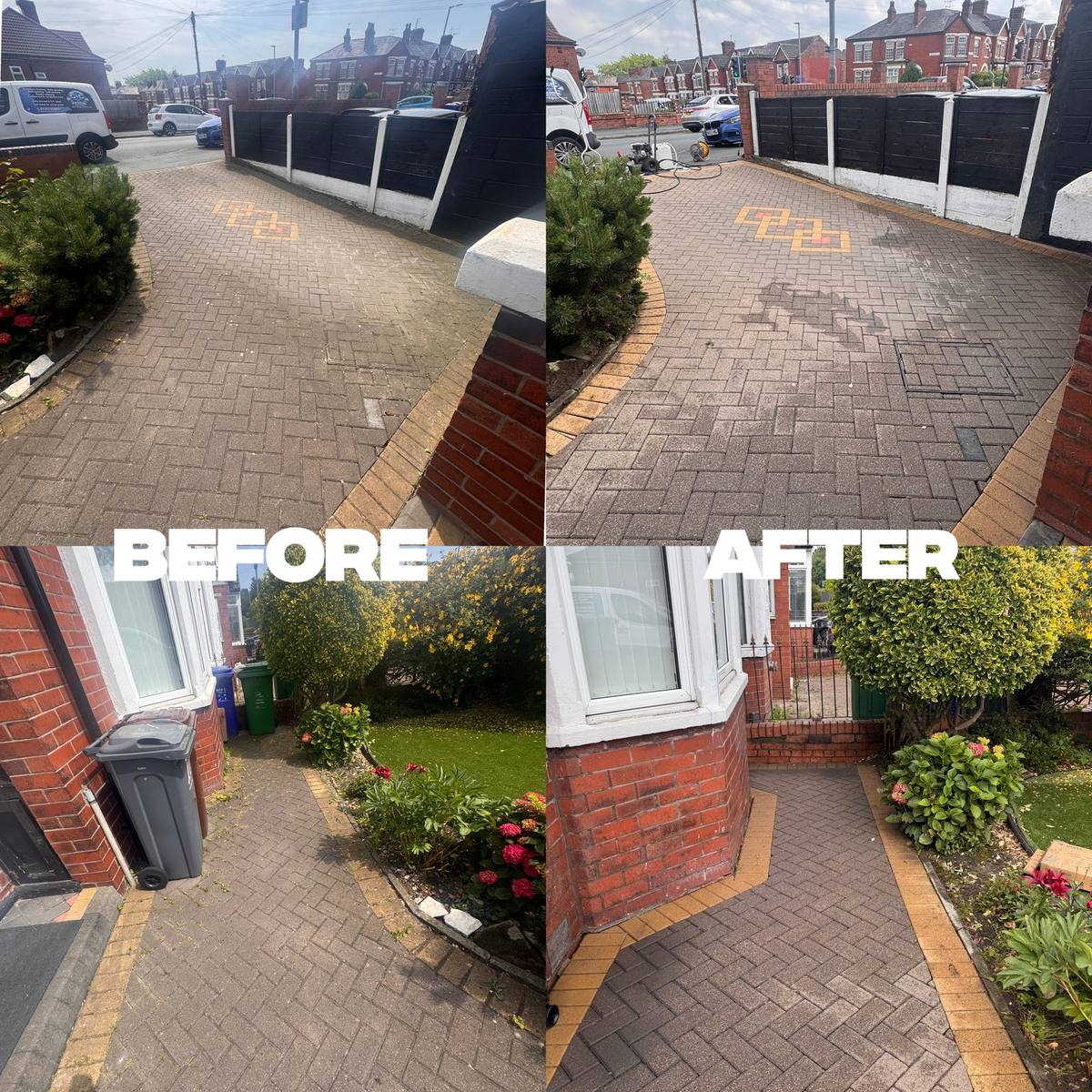
A proper clean restores colour and removes organic growth without damaging the surface.
Quick answer: Resin driveway cleaning requires low-pressure rinsing or a wide-fan nozzle — never a concentrated jet, which can dislodge the aggregate. Remove organic growth with a gentle biocide first, then rinse. Avoid bleach and rotary surface cleaners. Done correctly, resin driveways clean up quickly and last well.
What Is a Resin Driveway and Why Does Cleaning It Differ?
There are two main products sold under the "resin driveway" label and they behave quite differently. Resin bound is the permeable type — aggregate stones are mixed with a clear resin and laid as a smooth, porous surface that allows water to drain through. Resin bonded is a different system where resin is applied to an existing base and aggregate scattered on top, producing a rougher, non-permeable finish. Most modern installations in this region are resin bound, and that's the type most likely to be damaged by aggressive cleaning.
The reason resin bound differs from concrete, block paving or tarmac is structural. On block paving or concrete, a rotary surface cleaner or high-pressure lance removes grime from a hard, dense surface that can take the force. With resin bound, the aggregate stones are held in place by a resin binder that — particularly as it ages — can be loosened by concentrated pressure. Once stones start lifting, the surface becomes uneven, water pools rather than draining, and the only real fix is a full or partial relay. Setting that expectation early matters, because the cleaning approach needs to be calibrated around protecting that binder.
Resin bonded is slightly more forgiving in some respects because the aggregate sits on top of a solid base, but it has its own sensitivities — the bonded layer can delaminate if water gets underneath it or if pressure cleaning is done carelessly. In both cases, a gentler method than you'd use on tarmac or concrete is the right starting point.
The Dos: Safe Ways to Clean a Resin Driveway
Start with a soft-bristle brush to clear loose leaves, grit and debris before any water touches the surface. This matters more than it sounds — dragging wet organic matter across resin with a pressure washer spreads tannin staining and forces debris into the porous structure. A dry sweep first saves work later.
For the rinse, a fan-spray nozzle at low pressure — kept at a reasonable distance from the surface — is the appropriate tool. You're rinsing, not blasting. A pH-neutral detergent applied with a garden sprayer and allowed to sit for several minutes does more useful work than raw pressure. The dwell time is the important part: let the detergent break down the soiling before you rinse it away, rather than trying to use mechanical force to compensate for no chemistry. This principle applies across most exterior cleaning, but it's especially relevant on resin.
For moss and algae, a biocide or algaecide formulated for exterior hard surfaces is the correct product. Apply it, let it dwell according to the manufacturer's instructions — often 20 to 30 minutes, sometimes longer for heavy growth — and then rinse gently. The biology does the work. This is the same underlying principle used in softwashing, where chemical treatment rather than pressure is the primary method of removing organic growth.
The Don'ts: What Will Damage Your Resin Surface
Rotary surface cleaners are the single most common cause of damage on resin driveways cleaned by people who don't know the surface. They work brilliantly on block paving and concrete — they're a standard tool in driveway cleaning for good reason — but on resin bound they concentrate pressure at the contact point in a way that can dislodge aggregate, leave circular marks and permanently compromise the surface. Don't use them on resin.
Pencil-jet or 0-degree nozzles are equally problematic. The concentrated stream hits one spot with far more force than a fan spray and can cut into the resin binder even at moderate machine pressure. If you're doing this yourself, use a 40-degree fan nozzle and keep the machine pressure low — 1,200 psi is a reasonable upper limit, and less is often better. Wire brushes or stiff deck scrubbers cause surface abrasion and can scratch the aggregate. Stick to soft bristles.
On chemicals: neat sodium hypochlorite — the active ingredient in bleach and in professional softwash mixes — is not appropriate for undiluted use on resin. At high concentration it can degrade the resin binder and bleach pigmented aggregate, particularly on coloured installations. Some installers specify in their warranty documentation that certain chemicals void the warranty entirely. If you have the original installation paperwork, check it before you apply anything beyond plain water. When in doubt, test on an inconspicuous edge and wait 24 hours before proceeding.
Dealing with Moss, Algae and Weeds on Resin
Organic growth is the most common complaint with resin driveways in the North West, and honestly it's not surprising. Greater Manchester's wet, mild winters and overcast summers create near-ideal conditions for moss and algae to establish themselves on any outdoor surface that doesn't see regular foot traffic. North-facing or partially shaded driveways can go from clean to green in a single season.
The correct approach is chemical pre-treatment before any physical removal. Applying a biocide and allowing it to dwell kills the growth at the root. Trying to scrub or jet live moss without pre-treatment usually spreads spores, redistributes organic matter and does little to prevent regrowth. After treatment and dwell, the dead material rinses away far more easily and with much less pressure required. This is one of those cases where patience — waiting for the chemistry to work — genuinely produces a better result than working harder with a machine.
Weeds growing through the surface are a sign that the resin bound installation has developed gaps or that the installation itself wasn't perfect. Chemical weed treatment works for the top growth, but persistent weeds coming through the same spots usually indicate a structural issue rather than a cleaning problem. A professional opinion on whether the surface needs repair is worth getting before spending time on cleaning that won't hold.
Stains, Oil and Tyre Marks: What Actually Works
Oil drips from vehicles are a regular issue on any driveway, and on resin the outcome depends heavily on how quickly you deal with them. Fresh oil, blotted up quickly with an absorbent material and then treated with a pH-neutral degreaser, can lift without leaving a permanent mark. Oil that has been sitting for weeks and has soaked into the resin binder is a different matter — it may lighten with treatment but is unlikely to disappear entirely. Being honest about that is more useful than promising results that aren't realistic.
Tyre rubber marks — the dark scuffs left by cars turning tightly — can sometimes be reduced with a suitable degreaser and gentle agitation, but they're among the harder stains to shift on resin. The rubber has effectively bonded with the surface. Improvement is possible; complete removal usually isn't.
Leaf tannin — the brown staining left by wet leaves sitting on the surface through autumn and winter — responds reasonably well to a pH-neutral cleaner with some dwell time, particularly if the staining is recent. Older tannin that has been through several freeze-thaw cycles tends to be more stubborn. The same honest caveat applies here: you may see significant improvement, but some discolouration is absorbed into the surface over time and becomes part of it.
If you're trying a cleaning product on a resin driveway for the first time, apply it to a small area at the edge or behind a gate post — somewhere that won't be visible if the result isn't what you hoped. Wait 24 hours before proceeding across the full surface. Resin can react unpredictably to products not designed for it, and a small test costs nothing.
When to Call a Professional Instead of DIYing It
There are situations where having a go yourself is a reasonable option and situations where it isn't. If the driveway has light surface soiling and you're confident with a low-pressure rinse and appropriate detergent, DIY maintenance is fine. If there's heavy moss or algae colonisation across the whole surface, if the resin is showing signs of aggregate loss or the colour has changed significantly, or if the driveway is large enough that doing the job properly would take a full day, a professional clean is likely to produce a better result with less risk.
Older resin installations — anything over eight to ten years old — tend to have a binder that's more brittle and more susceptible to pressure damage. If you're unsure of the installation age or have no documentation, treat the surface cautiously. Similarly, if the original installer's warranty is still in effect, using incorrect methods or products could invalidate it, which matters if you ever need to make a claim for surface defects.
C&C Precision covers Oldham, Rochdale, Bury, Bolton, Manchester, Tameside, Stockport and surrounding areas, and the quickest way to get a price is to send a few photos over WhatsApp — you'll typically hear back the same day. Seeing the actual surface rather than working from a description makes a real difference to the accuracy of the quote.
Quick Takeaway: Resin Driveway Cleaning Checklist
The key points from this guide, in a format you can refer back to:
- Dry sweep loose debris before applying any water or product
- Use a fan-spray nozzle only — no rotary surface cleaners, no pencil jets
- Keep pressure below 1,200 psi and stand well back from the surface
- Use pH-neutral detergents; allow dwell time before rinsing
- For moss and algae, apply a biocide first and let it work before rinsing
- No neat sodium hypochlorite; no wire brushes; no stiff scrubbers
- Test any new product on a hidden edge and wait 24 hours
- Check installer warranty before applying any chemical treatments
- Accept that some stains — absorbed oil, old tannin — may lighten but not vanish
For maintenance frequency, a light brush and rinse two or three times a year keeps surface debris from building up and reduces the rate at which organic growth establishes. In Greater Manchester's climate, a professional deep clean every one to two years is a realistic schedule for most resin driveways — enough to keep the surface looking right without over-cleaning something that doesn't need it. If you're curious about how weather and seasonal timing affect exterior cleaning more broadly, the guide on preparing your home exterior for winter is worth a read before the colder months arrive.
Frequently asked questions
Can you pressure wash a resin driveway?
Yes, but with strict limits. A fan-spray nozzle at low pressure — typically no more than 1,200 psi and kept well back from the surface — is generally safe. A concentrated pencil jet or rotary surface cleaner generates far too much pressure at the contact point and can dislodge aggregate from the resin binder, particularly on older or thinner installations.
Will bleach damage a resin driveway?
Neat or high-concentration bleach (sodium hypochlorite) can degrade the resin binder over time and may bleach the colour out of pigmented aggregate. A diluted, professionally applied biocide is the correct product for killing moss and algae on resin. If in doubt, test any chemical on a hidden edge first or get a professional in.
How often should a resin driveway be cleaned?
In Greater Manchester's climate, organic growth — moss, algae and lichen — can take hold within a single season in shaded or north-facing areas. A professional deep clean every one to two years, combined with a light brush and rinse a few times a year, keeps most resin driveways in good condition without over-cleaning.
How much does resin driveway cleaning cost in Greater Manchester?
Price depends on size, the level of organic growth and access. The quickest way to get an accurate figure is to send a few photos over WhatsApp — C&C Precision typically comes back with a price the same day. There's no obligation and no guesswork from a vague description.
Not sure if your resin driveway needs a professional clean?
Send a photo over WhatsApp and we'll give you a straight, fast quote — no fuss.