Render problems are one of the more common calls we get across Greater Manchester, and render cleaning Bolton enquiries in particular come in regularly — especially in the wetter months when green algae and orange staining seem to appear overnight on the sides of semis and terraces. Bolton has a specific combination of climate and housing stock that makes rendered walls more prone to biological growth and general weathering than many people expect, and it's worth understanding what you're actually looking at before deciding what to do about it.
This guide covers the main types of render staining and discolouration you're likely to see on Bolton homes, explains why they happen, and gives you honest advice on what can realistically be done — whether you're considering tackling it yourself or thinking about bringing in a professional. Not every stain vanishes completely, and some surfaces respond better than others, so the aim here is to give you a clear picture rather than oversell what cleaning can achieve.
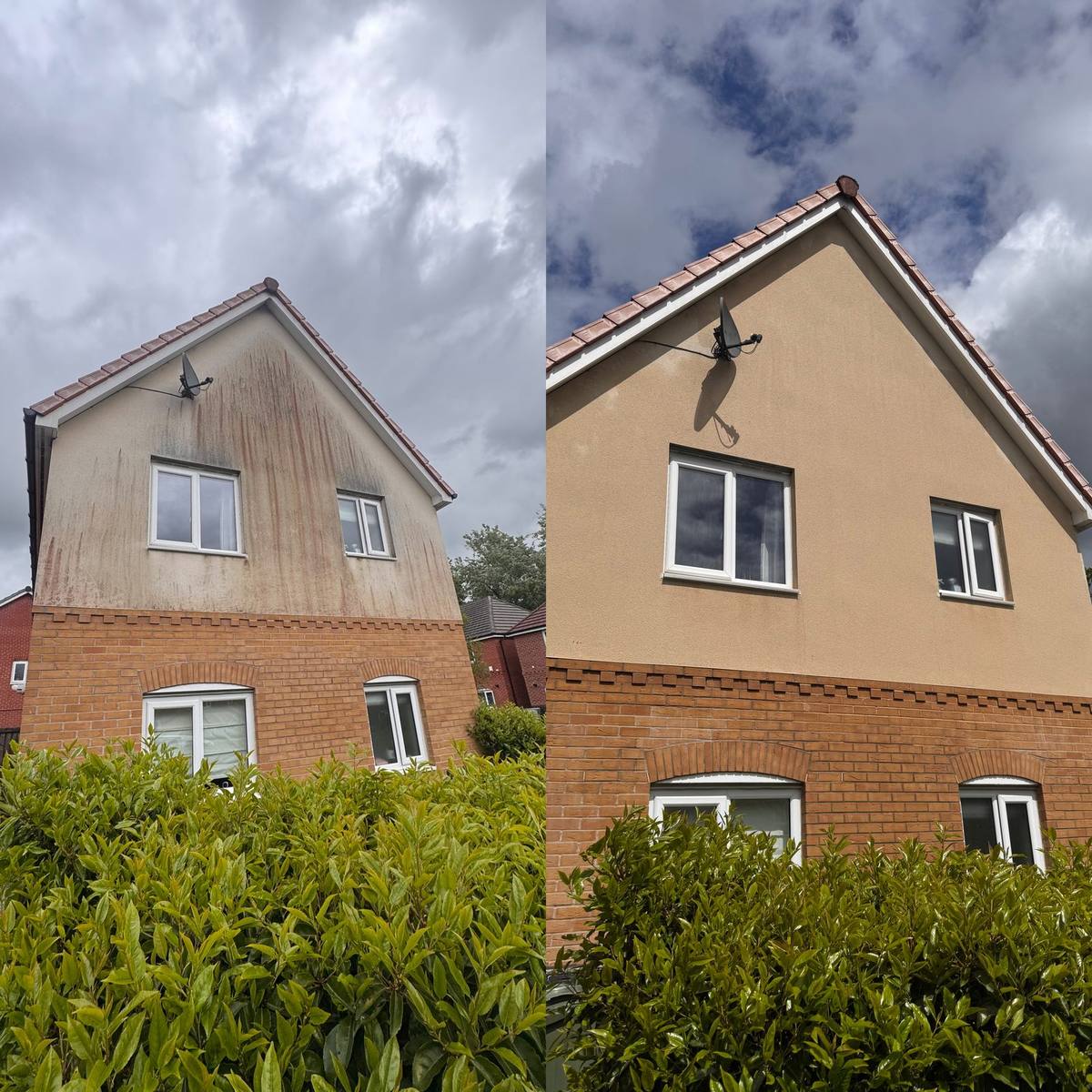
Before and after softwash render cleaning — red algae fully cleared on a K-Rend finish.
Quick answer: Bolton homes with rendered walls commonly suffer from green algae, red algae, black mould, and general grey weathering caused by the town's damp northern climate. Softwashing with sodium hypochlorite kills organic growth at the root, restoring render without damaging the surface — results typically last several years.
Why Bolton Homes Are Particularly Prone to Render Problems
Bolton sits in a wet, wind-exposed part of Greater Manchester with higher annual rainfall than areas further east and persistent low cloud that keeps moisture on surfaces for longer. The town is also relatively elevated in places, with westerly weather systems rolling in across open ground before the Pennines. That combination — frequent rain, limited drying sun on north and west-facing walls, and cool temperatures through much of the year — creates near-ideal conditions for algae, mould and lichen to establish on rendered surfaces faster than in drier parts of the country.
The housing stock adds to this. Bolton has a large proportion of older terraces and semis, many of which have been re-rendered at some point using modern thin-coat or monocouche finishes applied over original pebbledash or brick. These finishes look good when new but have a textured surface that holds moisture and gives biological growth plenty of purchase. Even newer builds on the outskirts — with their K-Rend or similar coloured finishes — aren't immune, particularly where they're partially shaded by neighbouring properties or garden trees.
The short version is that if you live in Bolton and have rendered walls, some degree of biological growth or weathering over time isn't a sign that something has gone wrong — it's just the local climate doing what it does. The question is how to manage it sensibly.
Green Algae: The Most Common Render Cleaning Problem in Bolton
A green or grey-green film creeping up from the base of a wall, or spreading outward from a downpipe or window sill, is almost always algae. It tends to establish first in the lowest sections of a wall where splash-back keeps the render damp, and on north-facing or shaded elevations where the sun rarely reaches. From there it spreads steadily upward and across, following the moisture gradient in the render.
The frustrating thing about algae is that it can look worse when the wall is wet and almost invisible when it's dry, which makes it easy to underestimate how established it's become. Once it has colonised the render properly, scrubbing with household cleaners won't shift it — you're removing the surface layer but leaving the root structure embedded in the render's texture, and it returns within weeks. Professional softwashing uses a sodium hypochlorite-based biocide applied at low pressure with adequate dwell time to kill the organism fully, which is why results last significantly longer than a scrub-down or a rinse with a domestic pressure washer.
Results are generally very good on smooth or light-texture renders. Heavily textured finishes and pebbledash can take longer to respond and may need a follow-up application. The render should progressively lighten over the weeks after treatment as the dead growth weathers away — the transformation isn't always instant, and it's worth knowing that going in.
Red and Orange Staining on K-Rend and Monocouche Renders
If you've noticed rust-coloured or orange patches on a newer coloured render — particularly common on Bolton new-builds and renovated semis with K-Rend or Weber finishes — it's almost certainly not rust and it's not a product defect. The culprit is usually Trentepohlia, an orange-pigmented algae-like organism that thrives in damp, humid conditions and is particularly visible on coloured renders because it contrasts so sharply with the background. It's widespread across the North West.
Red algae can appear as well, often in a similar pattern — starting on lower sections or around fixings and spreading outward. Both organisms respond well to softwashing, which is also the manufacturer-recommended cleaning method for K-Rend and similar products. High-pressure washing on these finishes is a genuinely bad idea: the surface layer is thin, the colour is integral to the render, and getting the pressure wrong can leave visible tracking marks or strip texture unevenly. Our render cleaning service uses low-pressure application throughout for exactly this reason.
The good news is that orange and red biological staining on coloured render typically clears well with the right chemical treatment. The render's colour underneath is usually unaffected — the staining is entirely on the surface, not in the material itself.
Black Mould and Lichen on Older Pebbledash
Older pebbledash — the rough aggregate finish found on thousands of Bolton's Victorian and interwar terraces and semis — is a different challenge. The surface is highly textured, porous, and gives mould, lichen and moss dozens of tiny anchor points to establish in. Black spotting and dark crusted lichen patches are common, particularly on north-facing gable ends and rear elevations that see little direct sun.
The instinct with pebbledash is often to hire a pressure washer and blast it clean, but this is one situation where that approach causes more problems than it solves. High pressure can dislodge aggregate, crack the render coat, and drive moisture deeper into the wall — and once aggregate starts coming away, you're looking at repointing work rather than just a clean. Low-pressure softwashing is the correct approach: the biocide does the work chemically rather than mechanically, with no risk to the surface. It takes longer to show results on pebbledash than on smoother renders, and some deep lichen staining may lighten rather than fully disappear, but the underlying wall is left intact.
It's also worth noting that lichen, unlike algae, produces acids that can slowly damage the render surface over time. Getting it treated before it becomes heavily established is genuinely worthwhile, not just a cosmetic preference.
General Grey Weathering, Dirt Ingress and Traffic Grime
Not all render discolouration is biological. Properties near Bolton town centre, main arterial roads, or industrial areas often develop a uniform grey or brown weathering across all elevations — the result of atmospheric particulates, soot, and fine dust settling into the render's surface over years. This type of soiling doesn't have the patchy, spreading quality of algae; it tends to be more even and gets gradually worse rather than appearing in distinct colonies.
The reasonable news is that this kind of general grime almost always responds well to a professional clean, even when it looks like permanent discolouration. A combined chemical treatment and low-pressure rinse can remove years of atmospheric soiling and restore the render's original tone. Properties near busy roads may need cleaning more frequently than those in quieter residential streets — every two to three years is a realistic expectation rather than the three to four years you might get on a cleaner elevation.
If your render has both biological growth and general grime, a single softwash treatment typically addresses both. The chemical dwell kills the biological element while the rinse stage lifts the surface dirt.
When to Call a Render Cleaning Professional in Bolton
If green or orange algae has spread across more than one elevation, if black lichen is visibly establishing, or if a DIY attempt with household cleaners or a borrowed pressure washer hasn't made a meaningful difference, it's time to bring in a specialist. The risk with DIY on modern thin-coat renders is real — incorrect pressure can damage the finish in ways that aren't immediately obvious but become apparent when the surface starts to craze or absorb water unevenly. Some manufacturers' warranties are explicitly voided by high-pressure washing.
C&C Precision cover Bolton as part of their regular working area across Greater Manchester, and quotes are straightforward — send a few photos of the affected walls on WhatsApp and you'll usually have a price back the same day without a site visit needed. The job itself is clean, quiet, and low-disruption compared to pressure washing, which matters if you have neighbours in close proximity.
Before calling anyone, photograph your render on a dry day — preferably from the same angle on each elevation. It gives the contractor an accurate read on coverage and staining type, and you'll also have a useful before-and-after reference once the work is done.
For comparison, if you're also dealing with hard surfaces around the property — driveways, patios, or block paving — it often makes sense to have those looked at in the same visit. Driveway cleaning and patio cleaning are frequently combined with render work to get the whole exterior looking consistent, and scheduling them together usually works out more cost-effective than separate visits.
Practical Advice: What to Do About Your Rendered Walls
Start by photographing the affected elevations and making a note of which direction they face. North and west-facing walls will always need more frequent attention in this climate — that's not something any cleaning treatment can permanently change. If your property has substantial vegetation close to the walls, particularly ivy or overhanging trees keeping one elevation in near-permanent shade, factor that into your expectations about how long results will last.
Softwashing is the right treatment for almost every render type encountered on Bolton properties — modern monocouche, K-Rend, traditional sand-cement, and pebbledash included. If you're getting quotes from contractors, it's worth asking specifically what chemical they use and how they apply it. A sodium hypochlorite solution at the right dilution, applied with sufficient dwell time and rinsed at genuinely low pressure, is the standard professional approach. Any contractor proposing high-pressure washing on a modern thin-coat render should be questioned on that. You can read more about the method in detail on our softwashing page.
A properly executed softwash on render cleaning Bolton jobs should keep walls looking clean for two to four years depending on aspect, surrounding vegetation, and the level of atmospheric pollution at the location. It's not a permanent solution — nothing in an exterior cleaning context truly is in this climate — but it's the most effective and safest treatment available for rendered surfaces, and a realistic maintenance interval of every few years is manageable for most homeowners. If you're also dealing with moss on the roof at the same time, it's worth reading whether roof moss is something to worry about, as the same damp conditions that affect render tend to encourage growth up there too.
Frequently asked questions
Is softwashing safe on K-Rend and modern coloured renders?
Yes — softwashing is the recommended method for K-Rend and similar monocouche finishes. It uses a diluted sodium hypochlorite solution applied at low pressure, which kills algae and mould biologically rather than blasting the surface. High-pressure washing on these renders risks damaging the finish or stripping the colour.
How long does render cleaning last in Bolton's climate?
In most cases a professional softwash will keep render looking clean for two to four years, though north-facing or heavily shaded walls may see regrowth sooner. The treatment kills biological growth at the root rather than just washing it off, which is why results last significantly longer than a simple pressure wash.
Can you clean render without scaffolding?
For most standard semi-detached and terraced homes in Bolton, we can reach all elevations using extended lance equipment and telescopic poles from the ground — no scaffolding required. Larger detached properties or gable ends above two storeys may occasionally need a tower or access platform, which we'd flag at the quote stage.
How much does render cleaning cost in Bolton?
Price depends on the size of the property, the number of elevations, and how heavily soiled the render is. The fastest way to get an accurate figure is to send a couple of photos of the affected walls on WhatsApp — we can usually turn around a quote the same day without needing to visit first.
Got a rendered wall in Bolton that needs sorting?
Send a photo on WhatsApp and we'll come back with a fast, honest price — usually the same day.