Porcelain has become one of the most popular choices for outdoor patio surfaces across Greater Manchester over the last decade, and it's easy to see why — it's hard-wearing, looks sharp when clean and doesn't require the same maintenance as natural stone. But porcelain patio cleaning in Oldham and the surrounding area comes with its own set of considerations that catch a lot of homeowners out. The surface behaves differently to concrete, sandstone or block paving, and treating it the same way tends to cause problems.
This guide covers how porcelain patios get dirty in our climate, what the correct cleaning process actually looks like, where DIY tends to go wrong, and what you can expect to pay for a professional clean. It's written to give you honest, practical information — not to push you into booking anything.
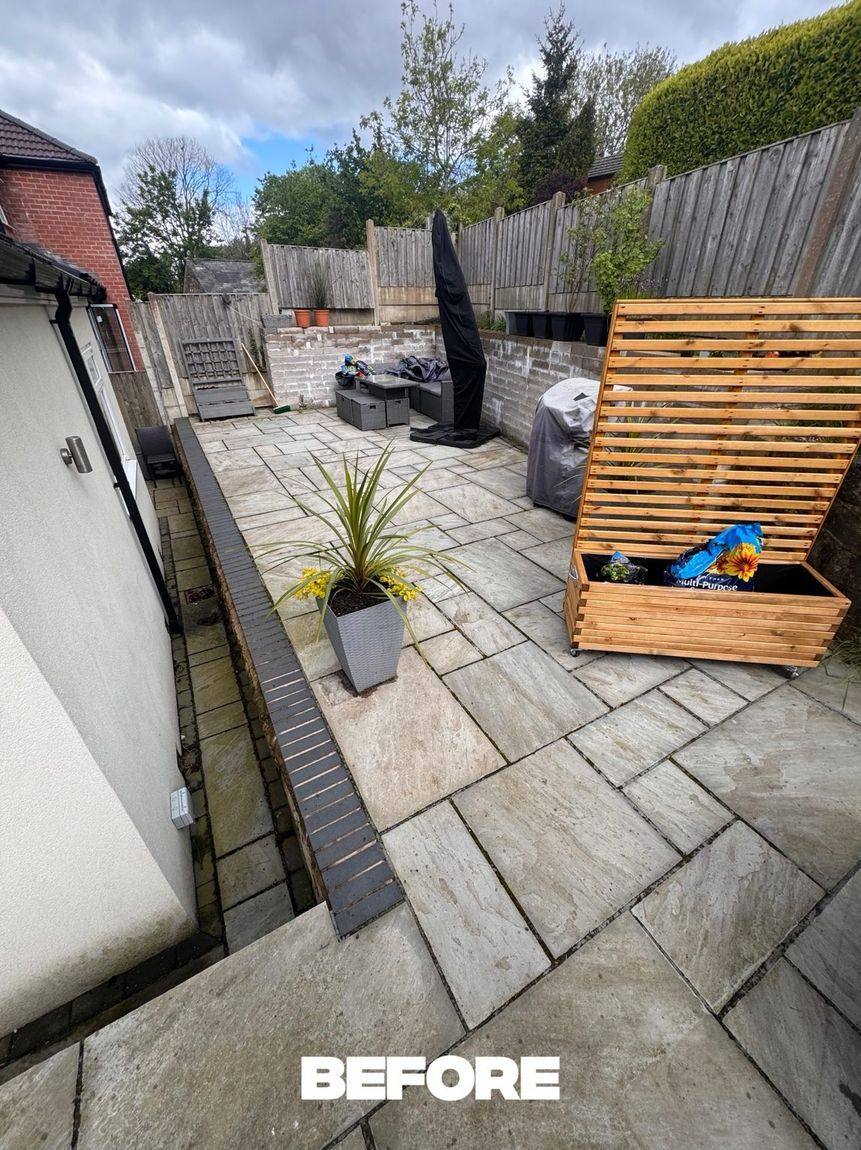
A typical porcelain patio in Greater Manchester before cleaning — algae, grime and traffic marks build up fast in our climate.
Quick answer: Porcelain patio cleaning in Oldham involves low-pressure washing combined with a suitable cleaning solution to lift algae, dirt and staining without scratching the glaze. Done correctly, porcelain is restored to its original colour without damage. Most residential patios in Greater Manchester are completed in a single visit.
Why Porcelain Patios Need a Different Approach
Porcelain is manufactured at very high temperatures, which produces an extremely dense, low-porosity tile with a glazed or textured surface finish. That density is part of what makes it so durable outdoors, but it also means it responds differently to pressure washing than a porous material like sandstone or riven concrete. Water, dirt and biological growth sit on the surface rather than soaking in — which sounds like a good thing, and in some ways it is, but it also means the grout joints between tiles become the main vulnerability.
Running a high-power rotary surface cleaner across porcelain — the kind of machine that works brilliantly on a tarmac or concrete driveway — is likely to leave pressure lines etched across the surface or erode the jointing between tiles. The glazed finish, particularly on smoother porcelain, can show swirl marks that are difficult to reverse. Understanding this is the foundation of doing the job properly.
There's also a practical point around grout. Many porcelain patios are laid with relatively narrow joints and jointed with a specialist pointing compound. Blasting those joints at full pressure doesn't just look bad — it undermines the structural integrity of the patio over time and leaves gaps that collect debris and encourage weed growth.
What Makes Porcelain Patios Dirty in Greater Manchester
The North West's climate does a lot of the work here. Oldham and the wider Greater Manchester area sit in one of the damper parts of England — we get consistent rainfall, frequent overcast days and limited sunshine hours to dry surfaces out between showers. That combination is ideal for algae, green mould and black spot lichen, all of which establish themselves quickly on any outdoor surface, including porcelain.
Porcelain's smooth finish can be deceptive. From a distance, a porcelain patio might look reasonably clean when in reality it has a thin but slippery biological film across the surface. This is the more serious problem — not the appearance, but the slip hazard. A wet porcelain patio with an algae layer on it is genuinely dangerous, particularly for children and older people. This is usually what prompts homeowners to get the patio cleaned, and rightly so.
Black spot lichen is a particular issue on north-facing patios or those that don't receive much direct sun. It anchors itself into the surface and doesn't shift with a basic rinse — it needs a proper chemical pre-treatment and dwell time to break the biological matter down before any mechanical cleaning begins. If you're also dealing with a moss and algae problem on your roof, chances are you're in a garden environment where spores are being distributed regularly, and the patio will likely need an annual clean to stay on top of it.
The Correct Process for Cleaning Porcelain Outdoors
A properly done porcelain patio clean starts before any water hits the surface. The right approach is to apply a pre-treatment solution — typically a diluted sodium hypochlorite mix or a dedicated biocide — evenly across the tiles and grout lines, then leave it to dwell. Dwell time varies depending on how heavily colonised the surface is, but as a general rule ten to twenty minutes is the minimum to start breaking down algae and lichen effectively. Rushing this stage and going straight to the pressure washer just moves the problem around rather than removing it.
Once the pre-treatment has done its work, the surface is rinsed using controlled, lower pressure — not a turbo nozzle held at point-blank range. For most porcelain, a fan nozzle at a sensible distance and moderate pressure will lift the loosened biological material without marking the glaze or damaging the pointing. On heavily soiled areas, a second application and dwell may be needed. Some stains — particularly deep-set grout discolouration — will lighten considerably but may not vanish entirely. That's worth being honest about upfront.
The grout lines need careful attention throughout. On patios where the pointing is already starting to deteriorate, aggressive cleaning will make it worse. In those cases, the joints may need to be raked out and repointed after cleaning — that's a separate job, and it's worth assessing the condition of the jointing before work starts so there are no surprises.
Always test your pre-treatment solution on an inconspicuous corner of the patio first, particularly on polished or lighter-coloured porcelain. Some finishes are more sensitive to strong chemicals than others, and a small test patch takes two minutes and could save you from a costly problem across the whole surface.
Common DIY Mistakes That Damage Porcelain
The most common problem is using a domestic pressure washer on full power with a turbo or pencil-jet nozzle. Domestic machines from hire centres or DIY shops often run at pressures that are fine for stripping flaking paint but far too aggressive for porcelain grout joints. The damage — etching, chipped tile edges, blown-out pointing — tends to happen quickly and isn't always obvious until the surface dries. By that point it's done.
Chemical choice is the other significant issue. Household bleach used undiluted, or at concentrations that aren't appropriate for the surface, can dull the glaze on some porcelain finishes over repeated applications. Acid-based cleaners — sometimes used on block paving to remove efflorescence — should not go near porcelain; they attack the grout and can affect the tile surface itself. If you're comparing the cleaning requirements across different surfaces, the approach for patio cleaning on natural stone or concrete differs quite a bit from what porcelain needs.
There's also the temptation to skip the pre-treatment and just pressure wash, which rarely gives a satisfactory result on biological growth. Without the chemical stage, you're relying entirely on mechanical force to remove material that's bonded to the surface — and that means either using more pressure than is safe, or accepting a result that looks better for a week and then greens back up quickly because the biological matter was disturbed rather than killed.
How Much Does Porcelain Patio Cleaning Cost in Oldham?
Pricing for porcelain patio cleaning in Oldham reflects the care the surface requires — it's not a job that can be rushed through with a surface cleaner in twenty minutes. As a rough guide, a standard residential porcelain patio clean with a biocide pre-treatment sits around £4.25 per square metre. That covers the chemical treatment and controlled pressure washing. A basic clean without chemical treatment would be towards £3.50 per square metre, though for most Greater Manchester gardens with our level of biological growth, the chemical stage is usually necessary to get a proper result.
Total job cost obviously depends on the size of the patio. A typical back garden porcelain patio of around 30–40 square metres would be in the region of £130–£170 for a full clean with pre-treatment. Larger patios, or those that haven't been cleaned in several years and have significant lichen or heavy staining, will take longer and may be priced accordingly. Getting an accurate quote is straightforward — a few photos sent over WhatsApp is usually enough to give a firm price without needing a site visit first.
When You Should Call a Professional Rather Than DIY
If your porcelain patio has heavy black spot lichen, significant grout discolouration, or hasn't been cleaned in three or more years, the honest answer is that a domestic pressure washer probably won't get the result you're hoping for — and there's a reasonable chance of causing damage in the process. Professional equipment gives better control over pressure and flow rate, and commercial-grade pre-treatment products are more effective at breaking down stubborn biological growth than anything available off the shelf.
It's also worth calling a professional if the tiles themselves are premium or expensive to replace. The risk calculation changes when you're looking at high-end porcelain that cost a significant amount to lay. Similarly, if you have elderly relatives using the patio, or young children, getting the biological film properly removed rather than partially disturbed is worth more than the saving from a DIY attempt. For those in the area, our patio cleaning service covers Oldham and the whole of Greater Manchester, and quotes are based on photos rather than guesswork. C&C Precision uses equipment and chemical combinations matched to the surface rather than a one-size-fits-all approach.
It's also worth noting that if you have other areas to address at the same time — a driveway, paths or block paving — combining them into a single visit usually works out more cost-effective than booking separate jobs.
How to Keep Your Porcelain Patio Cleaner for Longer
In the Oldham area and across Greater Manchester, a yearly clean is typically enough to keep biological growth from taking a serious hold. The key is not leaving it until the lichen has anchored deeply into the grout — at that stage, you need more treatment time and the results, while significantly better, may still show some residual staining in the joints. An annual clean before winter, when organic matter and leaf litter tend to accumulate, is a practical approach.
Keeping the patio clear of leaf litter makes a genuine difference. Wet leaves sitting on the surface hold moisture, create an acidic environment as they break down, and feed the algae and mould that then colonise the tiles. If the patio has drainage points, keeping them clear means water disperses rather than sitting. Overhanging trees or shrubs that reduce airflow and sun exposure will always mean more frequent biological growth — that's just the reality of our climate.
Porcelain is non-porous so it doesn't need sealing the way sandstone or block paving does. However, a grout sealant applied after cleaning can slow down how quickly biological growth re-establishes in the joints and help protect pointing that's in reasonable condition. It's not a magic solution, but it can meaningfully extend the interval between professional cleans. If you're curious about sealing in general and how long it tends to last on outdoor surfaces in this region, there's more detail in this guide on how long a sealed driveway lasts in Greater Manchester.
Frequently asked questions
Can you pressure wash porcelain patio tiles?
Yes, but pressure and technique matter a lot. Porcelain needs lower pressure than concrete or block paving — a full-power rotary surface cleaner can leave swirl marks or damage grout. At C&C Precision we adjust our equipment and approach depending on the surface, so the tile comes up clean without any damage.
How long does porcelain patio cleaning take?
Most residential porcelain patios in Oldham take between one and three hours depending on size and how dirty they are. We allow proper dwell time for pre-treatment solutions, which adds time but makes a real difference to the finished result.
Do porcelain patios need sealing after cleaning?
Porcelain is non-porous so it doesn't need sealing the way sandstone or block paving does. However, a grout sealant can help protect the pointing between tiles and slow down future biological growth. We can advise on whether it's worth doing when we assess your patio.
Do you clean porcelain patios across Greater Manchester or just Oldham?
We're based in Oldham and cover the whole of Greater Manchester including Rochdale, Bury, Bolton, Tameside, Stockport and Manchester itself. If you're not sure whether we cover your area, send us a message on WhatsApp and we'll confirm straight away.
Want a fast price for your porcelain patio?
Send a couple of photos of your patio on WhatsApp and we'll come back to you with a straight price — usually the same day.