If you've been searching for patio cleaning Rochdale, you're probably looking at a surface that's gone green, black, or just a shade of grey it was never meant to be. That's not neglect — it's almost inevitable given where we live. Rochdale sits in one of the wetter parts of Greater Manchester, and patios here have a hard time staying clean even when they're relatively new. The good news is that most surfaces clean up well with the right approach, and the job is usually quicker and more straightforward than people expect.
This guide covers how patios get dirty in the first place, what professional cleaning actually involves on the day, realistic pricing, and how to keep things looking decent between cleans. There's no upselling here — just a plain account of what works, what doesn't, and what to watch out for.
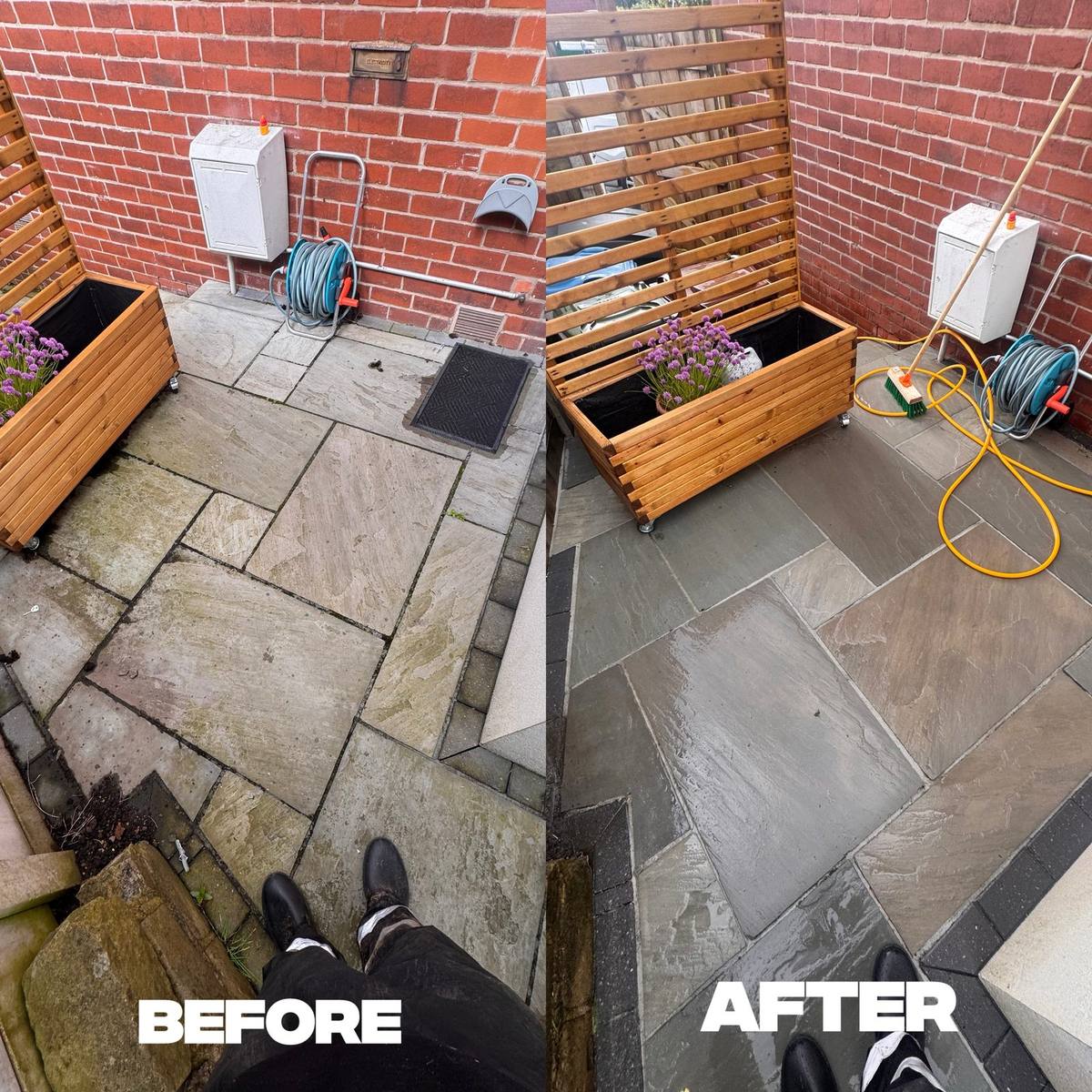
Indian sandstone patio — black spot staining and algae cleared on a recent job in Greater Manchester.
Quick answer: Patio cleaning in Rochdale typically costs £80–£250 depending on size, surface type, and condition. A professional will pressure wash or softwash the surface, remove moss, algae, and staining, and leave it safe to use same day. Most patios take one to three hours on site.
Why Rochdale Patios Get Dirty So Fast
Rochdale sits on the western edge of the Pennines, which means it catches a lot of moisture coming in off the Atlantic. Annual rainfall is consistently higher than the national average, and there are long stretches through autumn and winter where surfaces barely get the chance to dry out. That sustained damp is exactly what algae, moss, and lichen need to take hold — and once they're established, they spread quickly across any textured or porous surface.
Northerly and east-facing patios are the worst affected because they get less direct sun and stay damp longer. Even south-facing patios aren't immune — if there's a fence, a wall, or overhanging planting casting shade on part of the slab, that patch will go green while the rest stays relatively clean. Black spot — a stubborn fungal growth that penetrates into the surface rather than just sitting on top — is particularly common on Indian sandstone across this part of Greater Manchester, and it doesn't shift without either significant dwell time from a biocide treatment or proper mechanical cleaning, often both.
The result is that most Rochdale patios genuinely need attention every one to two years, not because the surface is poor quality but because the climate simply doesn't let things stay clean on their own. Regular maintenance is more cost-effective than waiting until the surface is heavily colonised and needs more intensive treatment.
Common Patio Surfaces in Rochdale Homes
Indian sandstone is probably the most common patio surface on residential properties across Rochdale and the wider Greater Manchester area. It looks great when clean but it's porous, which means algae and black spot penetrate the surface rather than just coating it. That affects the cleaning method — too much pressure and you start lifting the surface texture; not enough and you're just moving dirt around. Pre-treatment with an appropriate biocide, left to dwell properly before any washing starts, makes a significant difference to the final result on sandstone.
Porcelain has become far more popular in newer installations over the last decade. It's much denser and less porous than natural stone, which means it's more resistant to staining and generally easier to clean. A thorough pressure wash usually does the job well, and the surface is robust enough to handle it. Concrete slabs — the kind found on older properties — are similarly straightforward in most cases, though heavily weathered concrete can be more absorbent and may benefit from a surface treatment after cleaning. Block paving is a separate conversation altogether, because it has joints that need attention as well as the surface itself; more on that below, but you can read the detail in our guide to block paving cleaning.
Natural stone flags — Yorkshire stone, sandstone reclaimed from older properties — appear occasionally on period homes in the area. These vary considerably in how they respond to cleaning depending on age, porosity, and previous treatments. Results can be impressive, but it's worth being honest: some very old or weathered stone has deep-set staining that will lighten significantly without disappearing entirely. Setting realistic expectations beforehand matters more than overselling the outcome.
What Does Patio Cleaning Actually Involve?
Most professional patio cleans follow a similar sequence. First, any loose debris, moss clumps, or surface growth gets cleared away. Then a pre-treatment — usually a diluted biocide or algaecide — is applied across the whole surface and left to dwell. Dwell time matters: rushing this stage means the chemical hasn't had the chance to break down the organic growth properly, and you end up working much harder with the pressure washer to compensate. On heavily affected patios, fifteen to thirty minutes is typical; in cooler conditions it may be longer.
After the pre-treatment has done its work, the pressure washing starts. On most patio surfaces this means a surface cleaner attachment — a rotating head that keeps the pressure consistent across the whole area and avoids the streaky fan marks you get from holding a lance directly over the slab. Edges and tight corners get hand-lanced. Joints on block paving are treated separately; once cleaned, they'll need re-sanding with kiln-dried sand to restabilise the surface and prevent weeds and water from getting in — something covered in more detail on the block paving re-sanding page.
The finished result on most surfaces is a significant transformation — clean, bright, with the original colour of the stone or slab visible again. On patios with deep black spot penetration into sandstone, there may be some residual shadowing that fades over the following weeks as the treated growth dies back fully. That's worth knowing in advance rather than discovering after the job is done.
Patio Cleaning Prices in Rochdale: What to Expect
For a standard residential patio clean in Rochdale, most people pay somewhere between £80 and £250. A small concrete slab patio with moderate algae growth will sit at the lower end of that range. A larger Indian sandstone patio with established black spot and moss, needing pre-treatment and careful cleaning, will be higher. Surface type, degree of soiling, and overall area are the main variables.
For block paving specifically, pricing tends to work per square metre. A basic clean runs from around £3.50/m², rising to roughly £4.25/m² if a chemical treatment is included as part of the process. A full restoration — clean, treat, and re-sand the joints — is typically around £5.50/m², and re-sanding on its own (where the surface is already clean) sits at approximately £2.00/m². These are realistic figures for Greater Manchester; anyone quoting significantly below them is likely cutting corners somewhere, whether that's dwell time, equipment quality, or insurance.
Speaking of insurance — it's worth checking. Any contractor working on your property should carry public liability cover. Pressure washing can cause water ingress, surface damage, or dislodge pointing if done carelessly, and you want to know there's cover in place if something goes wrong. A contractor who can't confirm they're insured isn't worth the saving.
Pressure Washing vs Softwashing: Which Does Your Patio Need?
Pressure washing uses high-pressure water to mechanically remove surface contamination. It works well on concrete, porcelain, and most block paving where the surface is robust enough to handle the force. Softwashing, by contrast, uses low pressure with a sodium hypochlorite-based solution to kill organic growth at the root rather than blasting it off the surface. The contaminants — algae, lichen, moss, mould — are broken down chemically and then rinsed away gently.
For patios, softwashing on its own is less commonly the primary method than it is for vertical surfaces like rendered walls or roofs. You can read more about how that process works on the softwashing page. On horizontal patio surfaces, the more usual approach is a chemical pre-treatment combined with controlled pressure washing — you get the biological kill from the treatment and the mechanical cleaning from the pressure, and the combination gives better results than either alone.
If you have an older or delicate natural stone patio — particularly reclaimed flags or softer sandstone — be cautious about anyone proposing to clean it with maximum pressure without first assessing the surface condition. High-pressure washing on friable or previously damaged stone can lift the surface layer and cause permanent texture damage. A proper assessment before starting costs nothing and matters more than getting the job done quickly.
The surfaces where softwashing is genuinely the better choice for patios are those rare cases involving extremely porous or fragile stone where any significant pressure would cause damage. In those situations, a biocide treatment left to dwell and then rinsed with low pressure — and patience to let the growth die back over days and weeks — is preferable to forcing the issue with a pressure washer.
When to Call in a Professional Rather Than Hire a Machine
Domestic pressure washer hire is widely available, and for a quick freshen-up of a small, lightly soiled patio it can be adequate. The limitations become obvious quickly on anything more demanding. Consumer-grade pressure washers typically run at lower bar ratings than commercial equipment and lack the surface cleaner attachments that make the work consistent and streak-free. More significantly, they don't address the underlying biology — the algae and moss are removed from the surface, but without a biocide treatment, regrowth happens faster because the spores left behind have a head start.
There's also the surface damage risk. Holding a lance too close, using too narrow a nozzle, or spending too long on one spot are all easy mistakes that leave visible marks on sandstone, lift pointing from between slabs, or dislodge block paving jointing sand. Professionals use the right nozzle, the right pressure for the surface, and a surface cleaner that keeps things even across the whole area. That's not a trivial difference on a patio you've spent money on.
The practical cases where professional cleaning makes clear sense: patios larger than about 20–25 square metres where a day spent on your knees with a domestic machine isn't an appealing prospect; any natural stone or block paving where surface damage would be costly; and patios with established black spot or lichen where pre-treatment is essential to a decent result. C&C Precision covers the whole of Greater Manchester, and the fastest way to get a price is to send a couple of photos on WhatsApp — most quotes come back the same day.
How to Keep Your Patio Clean Between Professional Visits
The most effective thing you can do between professional cleans is keep organic growth from re-establishing itself. A stiff brush across the surface every few weeks during spring and autumn breaks up early-stage algae before it can grip. It takes five minutes and extends the time before the surface starts to look neglected. If you notice weeds pushing up through joints in block paving or between slabs, deal with them promptly — established roots disturb jointing sand and create gaps that let more growth in. For broader context on why drives and patios in this area go green so quickly, the guide on why your driveway goes green every winter covers the biology in more detail.
A diluted patio biocide applied once or twice a year — available from builders' merchants — can slow algae and moss regrowth noticeably. Apply it with a watering can on a dry day, leave it to work, and rinse. It won't clean a dirty patio, but as a maintenance treatment after a professional clean it's genuinely useful. Keep any planting back from the patio edges where you can; overhanging vegetation keeps surfaces shaded and damp, which is exactly the environment algae prefers.
As for how often most Rochdale patios realistically need a professional clean — in this climate, every one to two years is a reasonable expectation for a maintained surface. Leave it longer than that and you're generally looking at more intensive treatment, more time on site, and a higher cost. Staying on top of it with moderate frequency is cheaper in the long run than restoring a surface that's been ignored for several years. For patio cleaning Rochdale — and for the broader picture of keeping exterior surfaces in decent condition across Greater Manchester — regular light-touch maintenance combined with periodic professional attention is simply the most practical approach.
Frequently asked questions
How much does patio cleaning cost in Rochdale?
Most residential patios in Rochdale cost between £80 and £250 to clean professionally, depending on size, surface type, and how heavily soiled it is. A small concrete slab patio will sit at the lower end; a large Indian sandstone or porcelain patio with heavy black spot or moss will cost more. The quickest way to get an accurate figure is to send a couple of photos on WhatsApp.
How long does a patio clean take?
The majority of standard residential patios take between one and three hours on site. A heavily overgrown or larger patio may take longer. We'll give you a realistic time estimate when you get your quote so you can plan your day accordingly.
Can you clean Indian sandstone patios without damaging them?
Yes, but the method matters. Indian sandstone is a porous natural stone that can be damaged by excessive pressure or the wrong chemicals. We use controlled pressure and, where needed, appropriate pre-treatment to remove black spot and algae without lifting the surface or causing pitting. It's one of the most common patio surfaces we clean across Rochdale and Greater Manchester.
Do I need to be home when you clean the patio?
Not necessarily — as long as we have access to an outdoor tap and the area to be cleaned, most jobs can be carried out while you're out. We'll confirm the practical details with you beforehand so there are no surprises on the day.
Want a fast quote for your Rochdale patio?
Send a couple of photos on WhatsApp and we'll come back to you with a straight price — no sales call, no fuss.