If your patio or driveway has turned green, you're not alone — it's one of the most common questions we get asked, and the answer to what removes algae from paving is more involved than most people expect. A quick scrub or a blast with the pressure washer will clear it visually, but without treating the underlying organism, the green comes back within a season. Understanding why that happens, and what actually works, saves you from repeating the same job every spring.
This guide covers the biology behind algae growth, the chemistry that actually kills it, how different paving types need to be handled differently, and when it makes sense to bring in a professional rather than spending money on products that only half-solve the problem. Everything here is based on what we see day to day working on driveways, patios and paths across Greater Manchester.
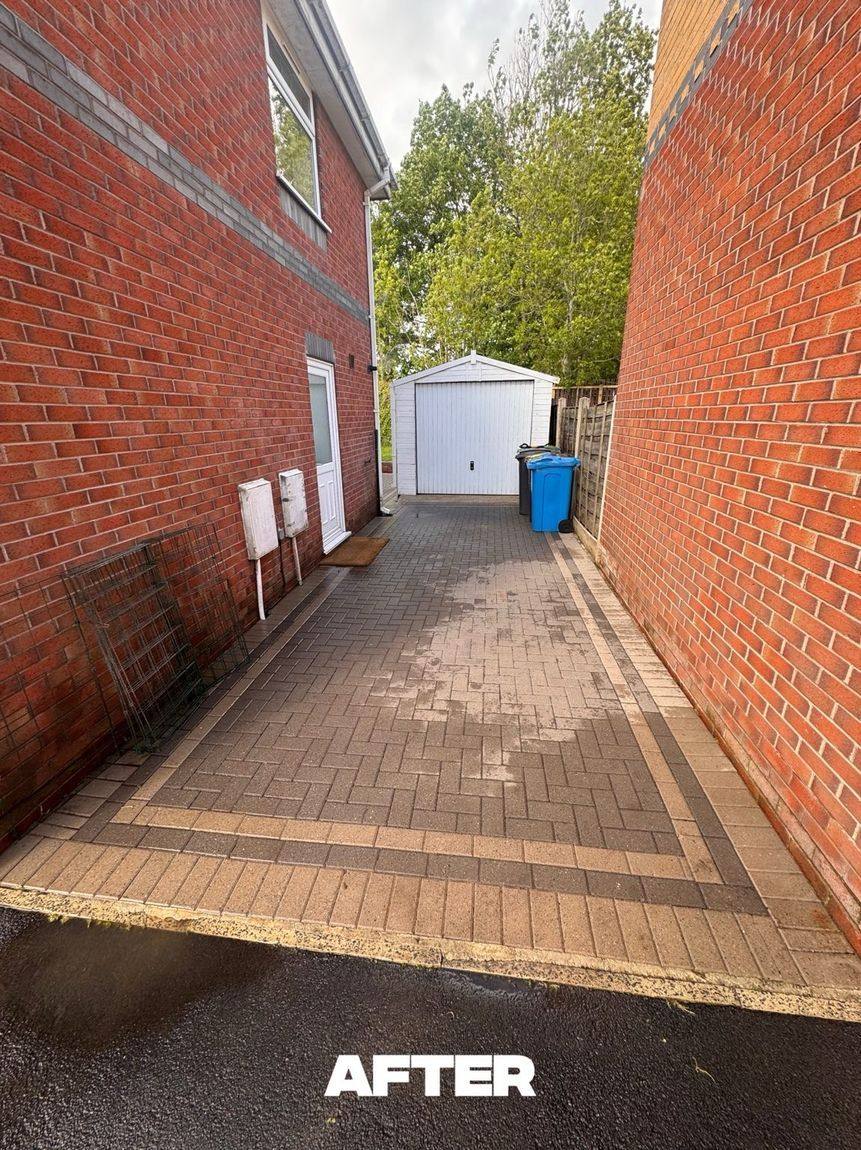
A rear patio in Greater Manchester — green algae gone after a full clean.
Quick answer: The most effective way to remove algae from paving is a combination of softwashing with a diluted sodium hypochlorite solution to kill the organism at the root, followed by pressure washing to clear the residue. For heavy build-up on block paving or patios, a rotary surface cleaner gives an even, streak-free finish.
Why Algae Grows on Paving in the First Place
Algae is a simple organism that needs very little to thrive — moisture, a surface to cling to, and some organic material to feed on. North West England provides all three in abundance. Greater Manchester averages well over 800mm of rainfall a year, and for a good part of the year the sun is low enough that paved surfaces stay damp for days at a time between dry spells. Add leaf debris, moss fragments, soil blown in from borders, and the typical north-facing aspect of many back gardens and alleyways, and you have near-ideal algae conditions.
It starts as a faint discolouration — often greenish-grey rather than the vivid green people associate with algae — and gradually builds into a visible biofilm. Once established, it holds moisture against the surface, which accelerates its own spread and can also contribute to surface degradation in porous materials like Indian sandstone. The reason surface-only treatments keep failing is that they remove the biofilm without affecting the spores embedded in the pores of the material. Those spores germinate again as soon as conditions allow, which in the North West is usually within a matter of weeks.
Why Pressure Washing Alone Isn't Enough
A pressure washer is an excellent cleaning tool, but that's all it is — a cleaning tool. It removes what's visible on the surface and, depending on the pressure and nozzle used, can shift a fair amount of embedded debris too. What it cannot do is kill algae at the organism level. The spores that cause regrowth are small enough and deeply enough embedded in the surface texture that water pressure alone does not remove them.
This is why so many people find themselves asking what removes algae from paving again just a few months after hiring a pressure washer or buying one. The paving looks clean immediately after the job, but within one season it's green again — sometimes greener than before, because the surface has been opened up slightly by the pressure and holds moisture more readily. On block paving in particular, incorrect pressure washing also displaces the kiln-dried sand from the joints, leaving the blocks loose and the surface vulnerable to weed growth, which compounds the problem.
Pressure washing is a necessary step in a proper clean — it removes the bulk material efficiently and leaves the surface ready for inspection and finishing work. But it needs to be part of a process, not the whole of it.
What Sodium Hypochlorite (Softwash) Actually Does
Sodium hypochlorite, diluted to the appropriate concentration for the surface type, is the active ingredient in professional softwashing and is the most reliable answer to what removes algae from paving in a way that actually lasts. Rather than physically removing the algae, it penetrates the biofilm and kills the organism at a cellular level — including the spores. Once the algae is dead, it can be rinsed away cleanly, and the surface is left in a condition where regrowth is significantly slower.
The dwell time matters. Applying the solution and rinsing it off immediately is less effective than allowing it to sit for a period that varies depending on the concentration used, the temperature, and how established the growth is. In cooler weather — which is most of the year in Greater Manchester — longer dwell times are sometimes needed. Professionals use dilutions calibrated for specific surfaces; the same concentration appropriate for concrete would damage more delicate natural stone, which is why surface assessment comes before application.
Softwashing is also used on other surfaces where high pressure would cause damage — render, roof tiles, and timber structures are common examples. The chemistry does the work rather than the force of the water, which is why it's effective on fragile or textured surfaces that couldn't handle a direct pressure wash.
Does White Vinegar or Bleach from the Supermarket Work?
White vinegar is mildly acidic and will affect some algae on contact, but it's not concentrated enough to kill established colonies reliably, and repeated application can affect the surface pH of certain natural stones in ways that aren't immediately visible but cause problems over time. It's also not formulated for outdoor use at scale — the volume you'd need to treat a full patio would be significant, and the results are inconsistent. On block paving or sandstone, it's not a method worth pursuing.
Household bleach is stronger, but the concentration and formulation are designed for domestic sanitation rather than outdoor surface treatment. It can discolour certain stone types — particularly Indian sandstone and some buff-coloured concrete products — and the surfactant package in domestic bleach isn't optimised for outdoor rinsing. There's also the question of runoff into planted borders, which matters if you have established planting alongside the paving. Professional biocides used in softwashing are formulated with safe dilution and rinsing behaviour in mind in a way that supermarket products simply aren't.
If you're buying an off-the-shelf patio cleaner, check whether it contains a biocide or is purely a detergent-based product. Detergent cleaners shift the dirt but don't treat algae — look for sodium hypochlorite or benzalkonium chloride in the active ingredients if you want a product that will slow regrowth rather than just clean the surface.
The Best Method for Different Paving Types
Porcelain paving is dense and non-porous, which makes it easier to clean — algae can't penetrate the surface, so it sits on top and responds well to a combination of softwash and a rotary surface cleaner at moderate pressure. Concrete flags and tarmac driveways are similarly tolerant of higher pressure settings. Indian sandstone is softer and more porous, and needs lower pressure with wider-angle nozzles to avoid surface fracture or stripping of the finish. If you're considering a full patio cleaning job on sandstone, the difference between correct and incorrect pressure settings is visible in the finished result.
Block paving presents a specific challenge because of the kiln-dried sand in the joints. That sand is what locks the blocks together and prevents movement. High pressure directed into the joints removes it, leaving the blocks shifting underfoot and creating gaps that weeds colonise quickly. A proper block paving clean uses a rotary surface cleaner to distribute pressure evenly and avoid channelling water into the joints, but even with the right equipment some sand loss is normal, which is why re-sanding is part of a full restoration. You can read more about that process in our guide to re-sanding block paving after cleaning. Typical pricing for block paving cleaning runs from around £3.50/m² for a straightforward clean, £4.25/m² with a full chemical treatment included, and £5.50/m² for a complete restoration with re-sanding. Re-sanding alone on a previously cleaned surface is around £2.00/m².
When the Job Is Better Left to a Professional
There's no shame in doing your own patio cleaning — a domestic pressure washer and a bit of time will improve a mildly algae-affected surface noticeably. But there are situations where professional equipment and chemistry deliver results that DIY genuinely can't match, and where attempting it yourself risks surface damage that costs more to fix than the original clean would have. If the surface is slippery enough to be a hazard, if you're dealing with valuable natural stone, if previous DIY jobs have left patchy or inconsistent results, or if the growth covers a large area that would take significant time to treat correctly, professional cleaning is the more sensible option when you factor in product costs, equipment hire, time, and the risk of getting it wrong. For paved drives specifically, our driveway cleaning in Oldham and Manchester covers treatment, cleaning and re-sanding in one visit.
C&C Precision Pressure Washing covers Oldham, Rochdale, Bury, Bolton, Manchester, Tameside, Stockport and the surrounding towns — if you want a fast quote, sending photos over WhatsApp is the quickest way to get accurate pricing without anyone needing to visit. The business carries £1,000,000 public liability insurance, which matters if anything unexpected happens to a surface during the clean. You can see what previous customers have said on the reviews page.
How to Slow Algae Regrowth After Cleaning
Once the surface is properly cleaned and treated, keeping it clear longer comes down to managing the conditions algae needs to re-establish. Clearing leaf debris promptly in autumn rather than letting it sit and decompose on the surface removes one of its main food sources. Trimming back overhanging shrubs and trees improves both airflow and light levels, which helps the surface dry more quickly after rain — damp, shaded paving is where algae always wins first.
Sealing is worth considering on block paving and Indian sandstone after a clean. A good penetrating sealer reduces the porosity of the surface, which makes it harder for algae spores to establish themselves and easier to clean off the early-stage growth before it becomes a problem. There are different sealer types — wet-look sealers that deepen the colour and natural-finish sealers that leave the surface looking unchanged — and the right choice depends on the material and the result you want. No sealer is permanent; most need reapplying every three to five years, and the surface should be clean before application or you're sealing the problem in rather than out. A well-maintained cleaned surface can realistically stay clear for two or three years in Greater Manchester conditions, which is a reasonable return on the cost of a professional clean.
Frequently asked questions
What is the fastest way to remove algae from paving?
A softwash application of diluted sodium hypochlorite followed by pressure washing with a rotary surface cleaner is the fastest method that actually lasts. Scrubbing or pressure washing alone is quicker in the short term but the algae returns faster because the spores aren't killed. For most domestic patios and driveways, a professional clean takes a few hours and leaves results that hold for one to three years.
Is green algae on paving dangerous?
Yes — wet algae on smooth paving surfaces becomes extremely slippery and is a genuine slip hazard, particularly on paths, steps and driveways used daily. It's one of the most common causes of garden-related falls, especially in autumn and winter in wetter climates like Greater Manchester. If your paving is noticeably green, treating it promptly is worth doing for safety reasons alone.
Will algae come back after pressure washing?
Almost certainly, yes — if pressure washing is used without a chemical biocide treatment. The pressure removes the visible growth but leaves spores embedded in the surface, which regerminate quickly in damp conditions. Combining pressure washing with a softwash treatment significantly extends the time before regrowth appears.
Does the type of paving affect how you remove algae?
It does, quite significantly. Porcelain and dense concrete can handle higher pressure than Indian sandstone or aged block paving, and some natural stones are sensitive to acidic treatments. Block paving also loses its kiln-dried sand jointing if pressure is applied incorrectly, which then needs re-sanding after the clean. A professional will assess the surface before choosing the method and pressure settings.
Got green, slippery paving you want sorted?
Send a photo on WhatsApp and we'll come back with a fast, no-nonsense price for your job.