If you've noticed your patio, path or yard slabs turning green, black or simply looking dull and tired, you're not alone. Slab cleaning in Oldham is one of the most common jobs we get enquiries about, and with good reason — the combination of heavy rainfall, low light and north-facing gardens means outdoor surfaces here rarely stay clean for long. What looks like ordinary dirt is usually a mix of algae, moss and biological crusting that has been building up for months or years, and it won't shift with a brush and some patio cleaner from the garden centre.
This guide covers the full process — what's actually involved, what you can realistically expect from a professional clean, how different slab types need to be treated differently, and when it's worth calling someone in rather than tackling it yourself. There's no sales pitch here, just a straightforward explanation of how it works and what it takes to get outdoor slabs looking the way they should.
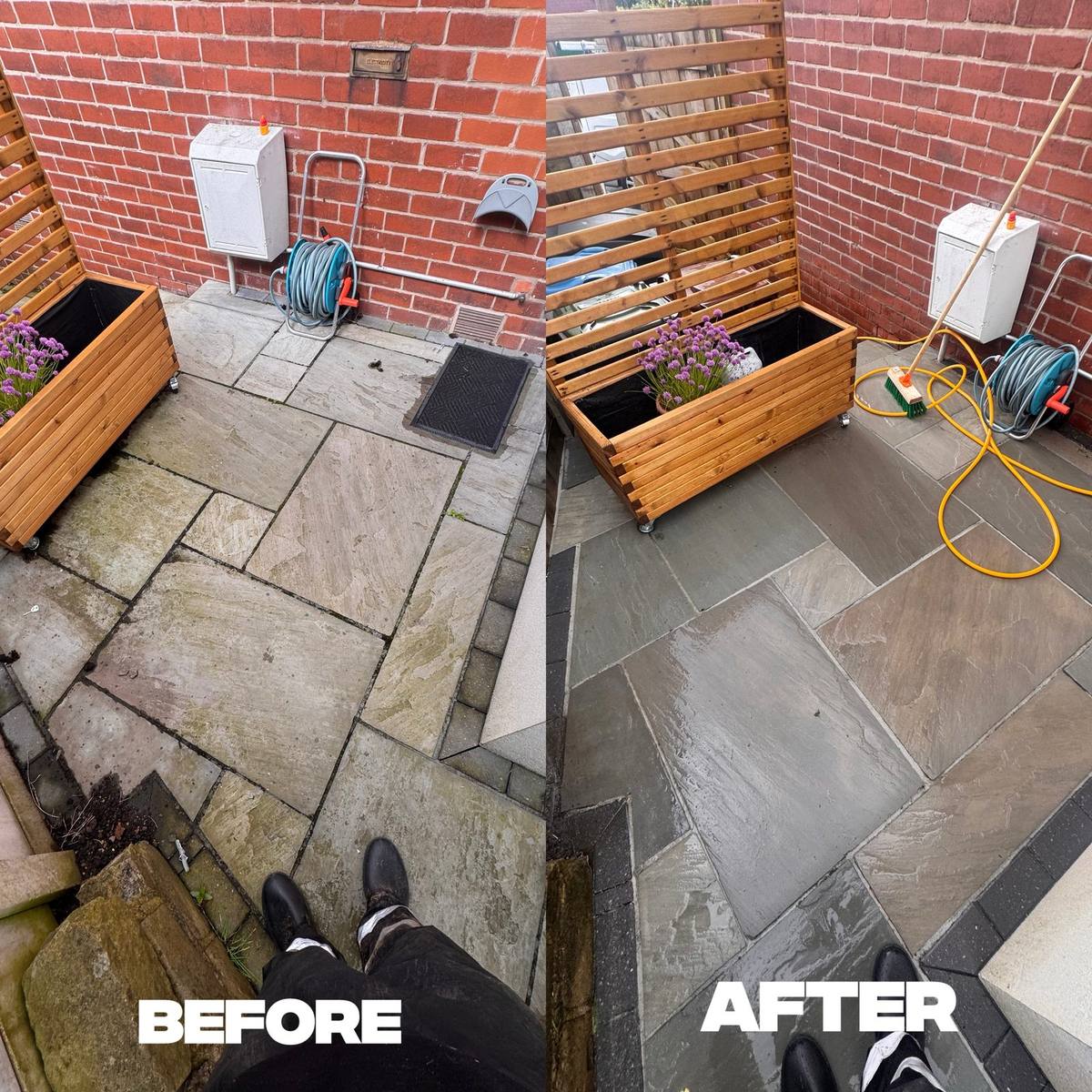
Indian sandstone slab cleaning job completed by C&C Precision in Greater Manchester.
Quick answer: Slab cleaning in Oldham involves high-pressure washing combined with pre-treatment to remove algae, moss, black spots and general grime from concrete, sandstone, porcelain and block paving slabs. A professional clean restores colour, improves safety underfoot and extends the life of your outdoor surfaces.
What Does Slab Cleaning Actually Involve?
A proper slab clean is more than pointing a pressure washer at the floor and hoping for the best. The first step is pre-treatment — applying a suitable detergent or biocide to the surface and allowing it to dwell. Dwell time matters because it breaks down the biological matter and loosens the bond between contamination and the slab before any water touches it. Skipping this step is why DIY efforts often shift surface dirt but leave the underlying green or black staining behind.
Once the pre-treatment has had time to work, a rotary surface cleaner is used rather than a lance. A rotary head delivers an even, consistent clean across the whole slab without the streaking you get from a handheld lance. After cleaning, the area is rinsed thoroughly to remove both the loosened debris and any chemical residue. The result is a uniform clean rather than the patchy, tiger-striped finish that comes from lance work alone.
The process varies depending on the surface. Concrete slabs are robust and can handle higher pressures. Indian sandstone is much softer and porous, requiring lower pressure and careful chemical selection to avoid opening the surface. Porcelain tiles are dense and non-porous, which actually makes them easier to clean but they're prone to chipping from direct lance contact. Block paving has joints that need separate attention — often re-sanding after cleaning to restore stability and weed resistance. Each material is a different job.
Why Oldham Slabs Get Dirty So Quickly
Oldham sits on the edge of the Pennines, which means it gets more rainfall than most of Greater Manchester and rarely sees the kind of prolonged dry spells that would slow biological growth. The town also has a high proportion of terraced properties with small, enclosed yards and back gardens that face north or north-east and receive very little direct sunlight for most of the year. Algae and moss thrive in exactly these conditions — persistent damp, limited UV exposure and surfaces that stay wet for extended periods.
The result is that slabs in Oldham often develop a thick green or black coating faster than homeowners expect. A new patio that looks clean in summer can be noticeably green by the following spring, and if it's left for two or three years it will often have visible moss growing in the joints, black spot algae embedded in the surface, and a slippery film across the whole area. This isn't a sign that the slab is poor quality — it's simply what happens to outdoor stone in this climate without regular maintenance.
The same pattern repeats across Greater Manchester. Gardens in Rochdale, Bury and Tameside face similar conditions, and south Manchester properties with shaded patios beneath trees or close to fences see the same rate of biological buildup. The climate is just not kind to outdoor surfaces, which is why professional slab cleaning in Oldham and the surrounding areas is a practical necessity rather than a luxury for most homeowners.
Common Problems We Find on Slabs in Greater Manchester
Green algae is the most common issue and also the most straightforward. It forms a thin, slippery film on the surface and is usually caused by moisture sitting on the slab without adequate drainage. It responds well to biocide pre-treatment and surface cleaning, though on heavily soiled slabs it often takes a couple of weeks after treatment for the dead algae to fully clear. Black spot algae — sometimes called tar spot — is more stubborn. It embeds itself into the surface of porous stone like sandstone and can be difficult to remove completely. In some cases it lightens significantly rather than vanishing entirely, which is worth knowing before you book a clean.
Moss and weeds in the joints are a different problem. Once moss establishes itself between slabs it begins to lift them slightly, holds moisture against the edges of the stone and accelerates weathering. Weeds growing up through joints do the same. These can be cleared as part of a thorough clean, but if the jointing sand is severely depleted, re-sanding the joints afterwards is the only way to stop them returning quickly. Oil stains — common on driveways and paths near vehicles — are some of the most resistant to cleaning. A degreaser pre-treatment will usually lift recent oil, but old or deep-set staining may only lighten rather than disappear completely. It's always worth being realistic about this before starting.
General discolouration from years of weathering, pollution and organic debris is usually the easiest issue to address. Slabs that look almost beyond saving often come back remarkably well once the biological growth is cleared and the surface is properly cleaned. The colour of the original stone becomes visible again, drainage channels clear, and the non-slip texture of the surface is restored — which matters for safety as much as appearance.
How We Clean Different Types of Slabs
Concrete slabs — the kind found on most driveways and many older patios — are the most forgiving to work with. They can handle a rotary surface cleaner at higher pressure, and most biological staining responds well to standard biocide pre-treatment. The main issue with concrete is oil staining, particularly on driveways, which needs a dedicated degreaser rather than just pressure and water. For general driveway cleaning on concrete, the combination of pre-treatment and rotary cleaning gives reliable, consistent results.
Indian sandstone is a different matter entirely. It's a soft, porous stone that scratches easily and absorbs staining readily. High pressure on sandstone strips the surface layer and can leave it looking rough and weathered. The right approach is a lower-pressure wash with appropriate pre-treatment and longer dwell time to do the work chemically rather than mechanically. The results on well-maintained sandstone can be excellent, though deeply embedded black spot may only partially clear. Patio cleaning on natural stone always involves adjusting the technique to the material — there's no single setting that works for everything.
Porcelain tiles are dense and don't absorb biological matter the way natural stone does, which makes them quicker to clean and less prone to deep staining. The main risk with porcelain is chipping from direct lance contact, so a rotary head and controlled pressure are important. Block paving combines a cleaning task with a jointing one — after the paving and joints are cleaned, kiln-dried sand needs to be brushed back into the joints to restore stability. You can read more about that process in our guide on how to clean block paving properly, which covers the full sequence in detail.
What to Expect From a Finished Job
A professionally cleaned patio or path should look genuinely transformed — restored colour, clear joints, and a surface that's safe to walk on rather than a slip hazard. On most slabs that have been neglected for one to three years, the difference is significant. Stone that looked almost permanently discoloured often comes back to something close to its original tone once the biological layer is removed and the surface is properly rinsed out.
That said, some results are limited by the condition of the slab. Deep oil staining, particularly on concrete that hasn't been sealed, may lighten rather than vanish. Black spot algae on sandstone that has been left for many years can be resistant even to prolonged chemical treatment. Slabs that have been physically damaged — cracked, spalled or eroded — will be cleaner after the job, but the underlying damage won't be reversed by cleaning. Being clear about this beforehand is more useful than promising a result that isn't always achievable.
For block paving specifically, cleaning alone often exposes just how depleted the jointing sand has become. If the joints are open, weeds will return quickly and the paving may begin to shift. Block paving re-sanding after cleaning — using kiln-dried sand brushed into the joints and compacted — is the right way to finish the job properly and gives the cleaned surface the best chance of staying in good condition.
If you're having sandstone or natural stone cleaned, ask about sealing afterwards. A breathable impregnating sealer on porous stone slows the reabsorption of algae and staining and makes future cleans easier and less frequent. It won't make the surface bulletproof, but in the Greater Manchester climate it makes a noticeable difference to how quickly the slab deteriorates between cleans.
When You Should Call a Professional Rather Than DIY
Hiring a consumer pressure washer from a tool hire shop and having a go yourself is fine for light surface dirt on robust concrete. For anything beyond that, the risks increase quickly. The most common DIY mistake is using too high a pressure on soft stone — sandstone in particular — which physically removes the surface layer and leaves the slab looking worse than before. The damage is irreversible. A scored or stripped sandstone patio can't be restored by cleaning it again more carefully; the surface is simply gone.
Jointing sand is another casualty of DIY pressure washing. Consumer washers used with a lance blast the sand out of block paving joints in minutes, leaving open channels that immediately fill with weeds and allow the paving to become unstable. A professional using the right equipment and technique loses far less sand and can re-sand as part of the same job. For anyone with block paving that hasn't been cleaned in several years, the safe choice is a professional clean rather than risking the joints.
Large areas, persistent biological growth that has resisted previous DIY attempts, delicate natural stone, or surfaces that haven't had any attention in three or more years are all situations where a professional is the more practical option. C&C Precision covers slab cleaning in Oldham and across Greater Manchester — a couple of photos sent over WhatsApp is usually enough to give a straight price without a visit. For commercial properties, yards and larger sites, our commercial pressure washing service covers everything from retail car parks to managed housing stock.
How to Keep Your Slabs Cleaner for Longer
The most effective thing you can do between professional cleans is remove organic debris before it breaks down on the surface. Fallen leaves left on slabs over winter create the ideal conditions for algae and black spot to establish — they hold moisture, block light and decompose into a nutrient layer that feeds biological growth. A regular brush-off in autumn and through the winter takes minutes and makes a genuine difference to how quickly the surface deteriorates.
Drainage matters too. Slabs that pool water or drain slowly towards a wall or fence stay wetter for longer and develop biological growth faster. Checking that gullies and drainage channels are clear, and that slabs are laid with enough fall to move water off the surface, reduces the conditions that algae and moss need to thrive. This isn't always easy to address retrospectively, but in shaded or north-facing areas it's worth thinking about if you're having paving relaid.
In terms of how often a professional clean is realistically needed in this part of the world, most surfaces benefit from attention every one to two years. Shaded or heavily used areas may need it annually. You can read more about this in our guide on how often patios should be cleaned, which gives a more detailed breakdown by surface type and situation. Sealing porous stone after a professional clean is worth considering — it slows resoiling and means the gap between cleans can extend noticeably, even in the damp conditions typical of Oldham and Greater Manchester.
Frequently asked questions
How much does slab cleaning cost in Oldham?
Price depends on the size of the area, the type of slab and how heavily soiled it is. A typical patio or path in Oldham will cost less than most people expect — the easiest way to get an accurate figure is to send a couple of photos over WhatsApp. We'll give you a straight price without needing to visit first.
Will pressure washing damage my sandstone or porcelain slabs?
It can, if done incorrectly. High pressure on soft sandstone strips the surface and opens the pores to faster resoiling. We adjust pressure and technique to suit the material — sandstone and porcelain are cleaned at lower pressures with appropriate pre-treatment, not blasted. The result is a thorough clean without surface damage.
How long will it take for my slabs to look dirty again?
In Greater Manchester's damp climate, algae and moss will return eventually — that's just the environment. A professionally cleaned surface typically stays noticeably cleaner for one to two years depending on shade, drainage and foot traffic. Sealing porous slabs after cleaning slows the return of staining and biological growth.
Do you clean slabs across Greater Manchester or just Oldham?
We're based in Oldham but cover the whole of Greater Manchester including Rochdale, Bury, Bolton, Manchester, Tameside, Stockport and the surrounding towns. If you're unsure whether you're in our area, just send us a message — we'll let you know straight away.
Want a price for your slab cleaning in Oldham?
Send a few photos of your slabs on WhatsApp and we'll come back to you with a straight price — no fuss, no obligation.