If you've been looking into getting your driveway, patio, render or roof cleaned, you've probably come across the question of pressure washing vs soft washing and wondered what the difference actually is. It's not just a marketing distinction — the two methods work in fundamentally different ways, and using the wrong one on the wrong surface can cause damage that's expensive to put right. Understanding which approach suits your property is the most useful thing you can do before spending any money.
Greater Manchester's climate doesn't help matters. The combination of persistent damp, low light and heavy rainfall means organic growth — algae, moss, lichen, black spot — builds up faster here than in drier parts of the country. Surfaces that might stay clean for three or four years further south can look neglected within eighteen months in Oldham or Rochdale. That growth needs treating correctly, and the answer isn't always to reach for the highest-pressure machine available.
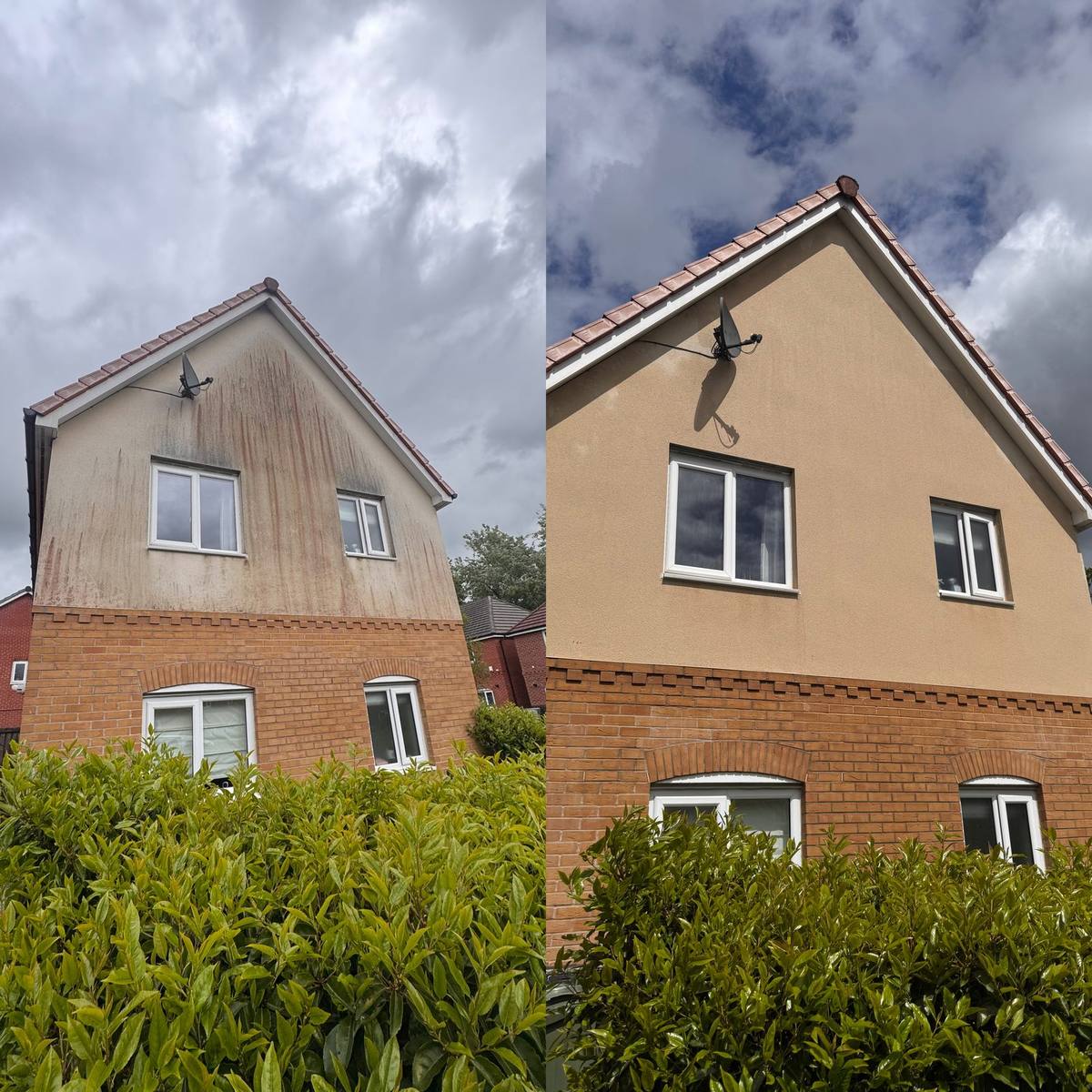
Softwashing removes red algae from rendered surfaces without high-pressure water that could cause damage.
Quick answer: Pressure washing uses high-powered water jets to blast dirt from hard surfaces like driveways and patios. Soft washing uses low-pressure water mixed with a sodium hypochlorite solution to safely kill algae, moss and bacteria on delicate surfaces like render, roofs and painted walls — without causing damage.
What Is Pressure Washing?
Pressure washing uses high-velocity water — typically somewhere between 1,500 and 4,000 PSI depending on the machine and the surface — to physically dislodge dirt, organic material and staining. The force of the water does the work: it strips moss, loosens compacted grime, flushes out weed growth and lifts surface discolouration from hard, dense materials that can handle that kind of force without being damaged.
The surfaces pressure washing works well on are those with structural integrity and density. Block paving driveways, concrete paths and aprons, tarmac, natural stone patios, flagstone and sandstone all respond well to it when the correct PSI is applied by someone who knows what they're doing. Commercial yard areas, car parks and retail forecourts are also well suited — the scale and robustness of those surfaces make pressure washing the practical and efficient choice.
Technique still matters enormously, even on appropriate surfaces. The angle of the lance, the distance from the surface, the speed of movement and whether a surface cleaner attachment is used all affect the result. Inconsistent technique leaves tiger-striping and uneven cleaning. On block paving in particular, too much pressure concentrated in one spot can displace the kiln-dried sand from the joints, which leads to weed ingress and instability if it isn't addressed with re-sanding after cleaning.
What Is Soft Washing?
Soft washing operates at low pressure — often not much more than a garden hose — but applies a biocidal solution, typically sodium hypochlorite with a surfactant added to help it cling to vertical surfaces. The chemistry does the work, not the water pressure. The solution dwells on the surface for a controlled period, penetrating organic growth and killing it at the root: algae, moss, lichen, bacteria and the spores that cause regrowth.
This distinction matters because pressure alone can remove what you can see without dealing with what's causing it. Blast the green algae off a render wall with high pressure and it looks clean — for a few months. The biological root structure is still there, embedded in the surface, and regrowth follows quickly. Soft washing kills the organism rather than just displacing the visible part, which is why results on render and roofing tend to last considerably longer.
The dwell time — how long the solution is left on the surface before rinsing — is an important part of the process and varies depending on the severity of contamination, the surface type and weather conditions. It's not a case of spray and rinse immediately. A professional softwash involves monitoring that dwell period, sometimes re-applying to heavily affected areas, and rinsing at low pressure to avoid driving moisture into the substrate.
Why the Wrong Method Can Cause Real Damage
Using high-pressure water on a surface that can't handle it causes damage that isn't always immediately visible but becomes apparent over time. On K-Rend and sand-and-cement render, pressure washing can blow the render clean off the wall, or force water behind it and into the masonry beneath. Even where the render stays in place, the finish is often pitted and roughened, which actually makes it more susceptible to algae regrowth than it was before.
Roof tiles are another common casualty. Concrete and clay tiles are more fragile than they look, and directing a pressure washer at them — which some operators do — can crack or dislodge them, damage mortar at the ridge and verge, and strip the protective surface from concrete tiles in a way that accelerates their deterioration. The same applies to older natural stone: softer sandstone and limestone can be eroded by high pressure, permanently altering the surface texture.
Pebbledash is a particular problem. The aggregate is set into a mortar bed, and high-pressure water strips it off. Once that happens, the wall looks patchy and worse than it did before cleaning, and the repair is neither cheap nor straightforward. These are common and costly mistakes, and they happen regularly when hired jet wash machines are used by people without the surface knowledge to know when to stop or switch methods.
Which Surfaces Need Pressure Washing?
Block paving driveways are probably the most common application for pressure washing in this part of the world. The surface is hard, jointed and robust, and cleaning it properly means getting into the joints to remove compacted moss, weeds and organic matter — something that requires meaningful pressure. You can read more about what's involved in the block paving cleaning process, including the preparation work that makes re-sanding effective.
Concrete paths, tarmac driveways, flagstone patios and natural stone paving all sit in the same category — surfaces with the density and hardness to take pressure without surface damage when the correct technique is used. Porcelain patio tiles are a slight exception: they can handle pressure washing but benefit from a lower PSI and a surface cleaner rather than a lance, because the grout joints are vulnerable. Garden walls in brick or hard stone, commercial forecourts and retail park surfaces are also appropriate candidates for commercial pressure washing.
Even on these surfaces, a biocide pre-treatment often improves the result. Applying a diluted algaecide before pressure washing helps loosen organic growth and reduces the pressure needed to shift it, which is gentler on both the surface and the jointing. It's an extra step, but it's the difference between a surface that stays cleaner for longer and one that's green again by the following spring.
Which Surfaces Need Soft Washing?
Rendered walls — whether K-Rend, monocouche, sand-and-cement or pebbledash — should only ever be cleaned by soft washing. There is no scenario where pressure washing render is the right choice. The sodium hypochlorite solution kills the biological growth that causes the green and black staining, and the low-pressure rinse removes it without stressing the substrate. If your render has gone green or black, render cleaning using softwash chemistry is the correct and only safe approach.
Roofs are the other major category. Whether the tiles are concrete, clay, natural slate or felt, the risk of physical damage from high pressure is too significant to justify it. Moss and algae on a roof need killing with biocide, not blasting off — and blasting can dislodge pieces of moss that then block gutters and downpipes as they wash away. Proper roof cleaning and moss removal involves applying the treatment, allowing dwell time, and often a follow-up application to deal with established lichen, which takes longer to respond than moss or algae.
UPVC fascias, soffits and cladding, painted masonry, conservatory roofing and any surface with a coating or finish that could be stripped by pressure all fall into the soft wash category. The logic is consistent: if the surface can be damaged by force, the cleaning chemistry needs to do the work instead of the water.
When You Should Call a Professional — Not Hire a Jet Wash
Hired jet wash machines are a common choice, and for washing a car or rinsing off a garden path they're fine. The problem is that they typically run at a fixed, high pressure with no adjustment for surface type, they come with no biocide capability, and the person using them has no way of knowing whether the surface they're cleaning can handle it. Most hire machines run hotter and harder than is appropriate for anything other than the most robust concrete, and the technique needed to use them well takes time to develop.
Roofs should never be DIY jet-washed. The physical risk alone — working at height on a wet, sloped surface — aside, the damage that results from incorrect pressure on roof tiles can lead to water ingress and repair costs far exceeding what a professional clean would have cost. Render is another situation where the consequences of getting it wrong are serious and visible. Older stonework — particularly softer sandstone garden walls and pathways — can be permanently eroded.
Block paving before re-sanding is also a job where professional judgement matters. The cleaning stage needs to be thorough enough to open the joints properly for sand to be applied, but not so aggressive that it damages the edge of the blocks or destabilises the bedding layer. C&C Precision carries out this work regularly across Greater Manchester, and the re-sanding step is what separates a restoration job from a surface that just looks temporarily cleaner. If you're thinking about the full process, the guide on re-sanding block paving after cleaning covers what's involved in detail.
Practical Takeaway: How to Decide Which Method You Need
The framework is straightforward. If the surface is hard, dense and structural — block paving, concrete, tarmac, flagstone, porcelain patio, stone — pressure washing is likely the primary method, though a biocide pre-treatment is worth considering. If the surface is porous, coated, rendered, clad or on a roof, soft washing is the correct approach. The question to ask is: would high-pressure water damage this surface, or drive water somewhere it shouldn't go? If the answer is yes, or even possibly, soft washing is the answer.
It's also worth noting that many properties need both methods applied to different surfaces in the same visit. A house might have a block paving driveway that needs pressure washing, K-Rend on the front elevation that needs soft washing, and a rear patio of Indian sandstone that benefits from a biocide treatment before lower-pressure cleaning. These aren't separate jobs that need different contractors — a professional with the right equipment handles them as part of the same visit.
If you're unsure which method your surface needs, the quickest way to get a straight answer is to send a photo over WhatsApp. A good operator will tell you honestly which method is appropriate, give you a realistic idea of the result, and quote from the image without needing to visit first.
Pricing varies by surface type and condition, but to give a rough idea: block paving cleaning starts from around £3.50/m², rising to approximately £4.25/m² where a chemical treatment is included. A full restoration including re-sanding runs from around £5.50/m², and re-sanding only — where the surface has already been cleaned — from £2.00/m². Render and roof soft washing is quoted based on the area and access involved rather than a per-metre rate. There's no obligation, and no pressure to commit before you're ready.
Frequently asked questions
Can you soft wash a driveway or patio?
You can apply a softwash biocide to a patio or driveway as a pre-treatment to kill organic growth before pressure washing — and it works well on porous Indian sandstone where harsh pressure can cause surface damage. However, for most driveways and hard paving, pressure washing is the primary cleaning method. Soft washing alone won't remove embedded grime and staining from block paving or concrete.
Is soft washing safe for K-Rend and sand-and-cement render?
Yes — soft washing is specifically the correct method for rendered surfaces. High-pressure washing can blow render off walls, damage the finish and drive water into the substrate. Softwashing with a correctly diluted sodium hypochlorite solution kills the algae and organic growth at the root and rinses off at low pressure, leaving the render clean and undamaged.
How long does soft washing last compared to pressure washing?
Soft washing tends to last longer on surfaces like render and roofs because it kills the biological growth rather than just removing it physically — so regrowth is slower. On a render or roof, results typically last two to four years depending on the environment. Pressure-washed surfaces like driveways and patios will need cleaning again every one to three years, depending on exposure, shade and foot traffic.
Does soft washing use bleach — is it safe for my garden?
Soft washing uses sodium hypochlorite, which is the same active compound as household bleach but applied at professional concentrations with surfactants to help it cling to surfaces. It can affect plants if it runs directly onto them in volume, so a professional will rinse surrounding vegetation before and after the treatment to minimise any risk. Once it has dried and broken down, it leaves no harmful residue.
Not sure which method your property needs?
Send us a photo on WhatsApp and we'll tell you exactly what's needed and give you a fast, no-nonsense quote.