If you've started looking into having your driveway cleaned and found the prices vary wildly, you're not imagining it. Driveway cleaning cost depends on a handful of straightforward factors — size, surface type, condition, and whether any follow-up work like re-sanding is needed — but the way some companies present their pricing makes it harder than it should be to get a clear answer. This guide is written for homeowners across Greater Manchester who want to understand what a fair price actually looks like before they contact anyone.
The North West's climate doesn't help driveways. Grey skies, persistent damp, and shade from terraced housing mean algae and moss take hold faster here than in drier parts of the country. A drive that looked clean eighteen months ago can look neglected today through no fault of your own. Understanding what the cleaning involves — and what it costs — means you're in a better position to choose someone who'll do the job properly rather than just make it look better for a season.
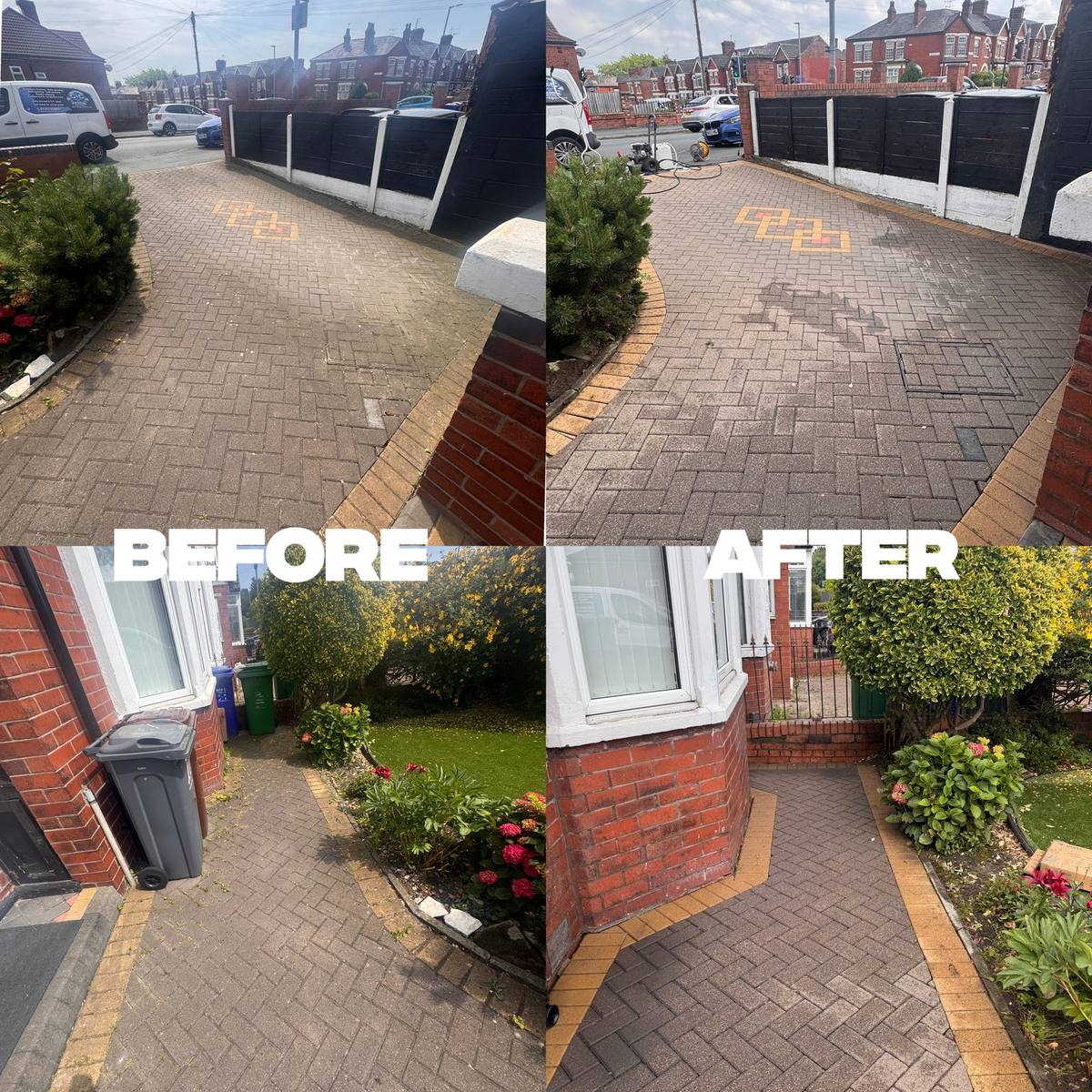
A wide concrete driveway cleaned by C&C Precision — the kind of job that typically sits in the £150–£250 range.
Quick answer: Driveway cleaning in the UK typically costs £80–£300 depending on size, surface type, and condition. A small block paving driveway costs around £80–£120, while a large concrete or tarmac drive can reach £200–£300. Prices vary by region — in Greater Manchester expect the lower end of national ranges.
What Does Driveway Cleaning Cost on Average?
For a small driveway — one car wide, around 20 to 30 square metres — you'd typically be looking at £60 to £120 for a professional clean in Greater Manchester. A medium driveway, two cars wide at 40 to 60 square metres, usually falls between £100 and £200 depending on condition and surface. Larger driveways of 80 square metres or more can run from £180 upwards, again depending heavily on what state it's in and whether re-sanding or sealing is part of the job.
Those ranges assume a straightforward clean with no serious complications. They give you a working expectation, not a fixed price. A driveway that hasn't been touched in five years and has an inch of moss growing through the joints is going to take longer to treat than one that's had a clean eighteen months ago. Any honest tradesperson will factor condition into their quote — if someone gives you a flat price without seeing the drive, that's worth questioning.
For a more detailed local breakdown, the driveway cleaning cost guide for Oldham and surrounding areas goes into further detail on what to expect across different towns in the region.
Prices by Surface Type: Block Paving, Concrete, Tarmac and More
Surface type is one of the biggest factors in both method and price. Block paving cleaning is the most involved — it typically runs from £3.50 per square metre for a standard clean, rising to £4.25 per square metre if a chemical treatment (usually a biocide to kill off algae and moss at the root) is included. The reason it costs more than plain concrete isn't just the labour. Block paving has joints that can be damaged by incorrect pressure, and the blocks themselves need working at an angle to shift ingrained dirt without disturbing the sand below. Done right, it takes time.
Concrete driveways are generally the most straightforward to clean. They can handle a wider range of pressures, there are no joints to worry about, and most discolouration responds well to a thorough hot wash. Tarmac requires more care — too much pressure on older or softer tarmac can lift the surface, so experienced operators will adjust accordingly. Resin-bound driveways are the most delicate of the common types and really shouldn't be pressure washed at all in the traditional sense. They respond better to a lower-pressure rinse and appropriate chemical treatment. If you're not sure what surface you have, a photo usually tells the story quickly enough.
Porcelain and natural stone are less common as driveways but do appear, particularly on newer builds and renovations. These surfaces need careful pressure control and sometimes specific cleaning agents to avoid etching or staining. The same principles apply as with patio cleaning on these materials — the method matters as much as the pressure.
What Else Affects the Price of Driveway Cleaning?
Condition is the single biggest variable after size. A drive with heavy moss, established weed growth through the joints, and years of tyre rubber and oil staining takes significantly longer to treat than a lightly soiled one. Some operators charge a flat rate and quietly rush the job on badly affected drives. Others — the ones worth hiring — will price the job honestly based on what they actually find.
Access matters too. A driveway that's straightforward to reach with a van and equipment is easier to price than one at the end of a passageway, up a steep slope, or with limited water supply nearby. Edge details — where block paving meets a lawn, a wall, or a channel drain — add time because they can't be done on a wide pass and need working by hand or with a lance. These aren't excuses to inflate a price; they're real factors that affect how long the job takes.
How long since the drive was last cleaned is worth mentioning to whoever quotes you. It helps them estimate treatment time and decide whether a biocide application is needed before the main clean. In Greater Manchester, driveways under tree canopy or on north-facing aspects can go from clean to badly mossed in a single winter. That's not unusual, and a good operator won't treat it as a problem — just a longer job.
Re-Sanding and Sealing: Are They Worth Adding?
After a deep clean on block paving, the jointing sand between blocks is often partially or fully washed out. That sand isn't decorative — it's structural. It holds the blocks stable, prevents rocking underfoot, and stops weeds taking hold as quickly. Re-sanding with kiln-dried sand is the proper way to restore the joint after cleaning, and it typically adds around £2.00 per square metre to the overall job cost. On a 50 square metre driveway, that's an extra £100, which is worth it. Blocks that aren't re-sanded after a clean tend to shift, and water finds its way beneath them faster. The guide to re-sanding block paving after cleaning covers this in more detail if you want to understand exactly what the process involves. A full restoration — clean, chemical treatment, and re-sanding — runs around £5.50 per square metre.
Sealing is a different question. A quality block paving sealer, applied correctly to a clean and dry surface, can help resist oil staining, slow the return of algae, and give the blocks a more consistent appearance. Some sealers are matt finish; others give a slight sheen. The honest answer is that sealing is worthwhile if it's done on a properly cleaned and re-sanded surface and you're prepared to re-apply it every three to five years. Applied over a dirty or damp surface, it traps the problem underneath and is difficult to remove. It isn't essential, but on a quality driveway that's been fully restored, it's a reasonable investment.
How Driveway Cleaning Costs Compare Across the UK
Greater Manchester sits comfortably below London and the South East for most trade work, and driveway cleaning is no different. In London, the same job might cost 30 to 50 percent more simply due to higher overheads and travel costs. That context is useful if you're comparing prices you've seen quoted online, where many figures are skewed upwards by national averages pulled from across the country.
Within Greater Manchester — whether you're in Oldham, Rochdale, Bury, Bolton, Tameside, or Stockport — prices tend to be broadly consistent. You might find slight variation between rural and urban areas, or where a contractor is travelling further, but the driveway cleaning cost figures in this guide represent what you'd reasonably expect to pay from a local, established operator. Unusually low quotes — say, £40 for a large block paving drive — are worth being cautious about. That kind of price usually means a very quick pass with a domestic machine, no chemical treatment, and no re-sanding. It's cheaper upfront and rarely represents value once you see the results six months later.
When Should You Call a Professional Rather Than Hire a Pressure Washer?
Hiring a pressure washer for an afternoon is a reasonable option for a lightly soiled concrete driveway with no joints to worry about. The machines available from hire shops are capable enough for basic work, and if you're comfortable operating one and know to keep the pressure reasonable, it can produce decent results. The limitations become obvious when the surface is block paving, render, or older material. Block paving joints are easily blown out by too much pressure or an incorrect angle, leaving the blocks loose and the drive looking worse than before you started. Render, similarly, can be damaged irreversibly by a pressure washer that's set too high or held too close. For surfaces where the method really matters, a professional who works on driveways every day is the better call.
Insurance is a practical point that's easy to overlook. If a contractor damages your driveway or a neighbouring property — broken fence panel, cracked render on a wall — their public liability insurance covers it. A friend with a pressure washer, or a cash-in-hand quote from someone with no insurance, leaves you picking up the bill if something goes wrong. C&C Precision Pressure Washing carries £1,000,000 public liability cover as standard, which is the minimum you should expect from any professional you let onto your property.
Before you hire anyone, check that they carry valid public liability insurance and ask to see a recent example of their work — either photos or a review from a customer in your area. A 5.0 Google rating from local customers tells you more than a smart website ever will.
Getting a Quote: What to Do Before You Call Anyone
Measure your driveway. Width multiplied by depth gives you the square metreage, and having that number ready means any quote you receive is based on the same information. You don't need to be exact — an estimate within five square metres is close enough. What matters is that you're not relying on someone guessing from a vague description like "about two cars wide."
Take a photo, ideally on a dry day with good light, showing the worst-affected area of the drive. A photo of the whole driveway plus a close-up of any particular problem — heavy moss, oil staining, damaged joints — gives a contractor enough to provide an accurate price without needing to visit first. Sending photos over WhatsApp is the quickest way to get a realistic quote. A description over the phone is helpful, but a photo removes any ambiguity and means you're comparing like-for-like when you get multiple quotes.
Ask specifically whether re-sanding is included, whether any biocide treatment is part of the job, and what the expected result is for any staining that's been there a while. A good operator will be honest about what pressure washing can and can't shift — some deep oil stains lighten significantly but don't disappear completely, and anyone who promises a pristine result on every surface regardless of its history isn't being straight with you. That honesty upfront saves a difficult conversation afterwards.
Frequently asked questions
How much does it cost to clean a block paving driveway?
A standard block paving driveway — say two cars wide and about 40–60 square metres — typically costs £100–£180 to clean professionally in Greater Manchester. If the joints need re-sanding with kiln-dried sand afterwards, add roughly £50–£100 on top. Heavy moss or weed infestation may push the price slightly higher due to extra treatment time.
Is professional driveway cleaning worth the money?
For most driveways, yes — especially block paving, where incorrect pressure can blow out the jointing sand and cause long-term problems. A professional clean removes algae, moss, and ground-in staining that a domestic pressure washer won't shift, and re-sanding restores the stability of the blocks. The results also tend to last significantly longer than a DIY effort.
How long does driveway cleaning take?
Most residential driveways take between one and four hours depending on size, surface type, and condition. A small tarmac or concrete drive might be done in an hour. A large block paving driveway with heavy moss growth, edge detailing, and re-sanding could take a full half-day. You'll normally get an honest time estimate when you request a quote.
How often should a driveway be professionally cleaned?
Every one to two years is a reasonable rule of thumb for most driveways in the North West, where damp weather accelerates algae and moss growth. Driveways under tree cover or in shaded spots may need attention more frequently. Staying on top of it means shorter, cheaper cleans rather than a major job every few years.
Want a fast, no-nonsense quote for your driveway?
Send a couple of photos on WhatsApp and we'll come back to you with a straight price — usually the same day.