Communal walkway cleaning is one of those jobs that often gets pushed down the list until someone slips, a letting agent gets a complaint, or an inspection flags the state of a shared entrance path. It covers everything from the paved footpath between two blocks of flats to the fire exit route at the back of a retail unit — any surface that multiple people use regularly and that nobody quite feels personally responsible for keeping clean. In Greater Manchester's wet climate, those surfaces deteriorate faster than most people expect.
This guide covers what the service actually involves, who arranges it, what the process looks like on the day, and when it makes sense to bring in a professional rather than trying to manage it with a domestic pressure washer and an afternoon to spare. The aim is to give property managers, landlords and residents' groups a straightforward picture so they can make a sensible decision.
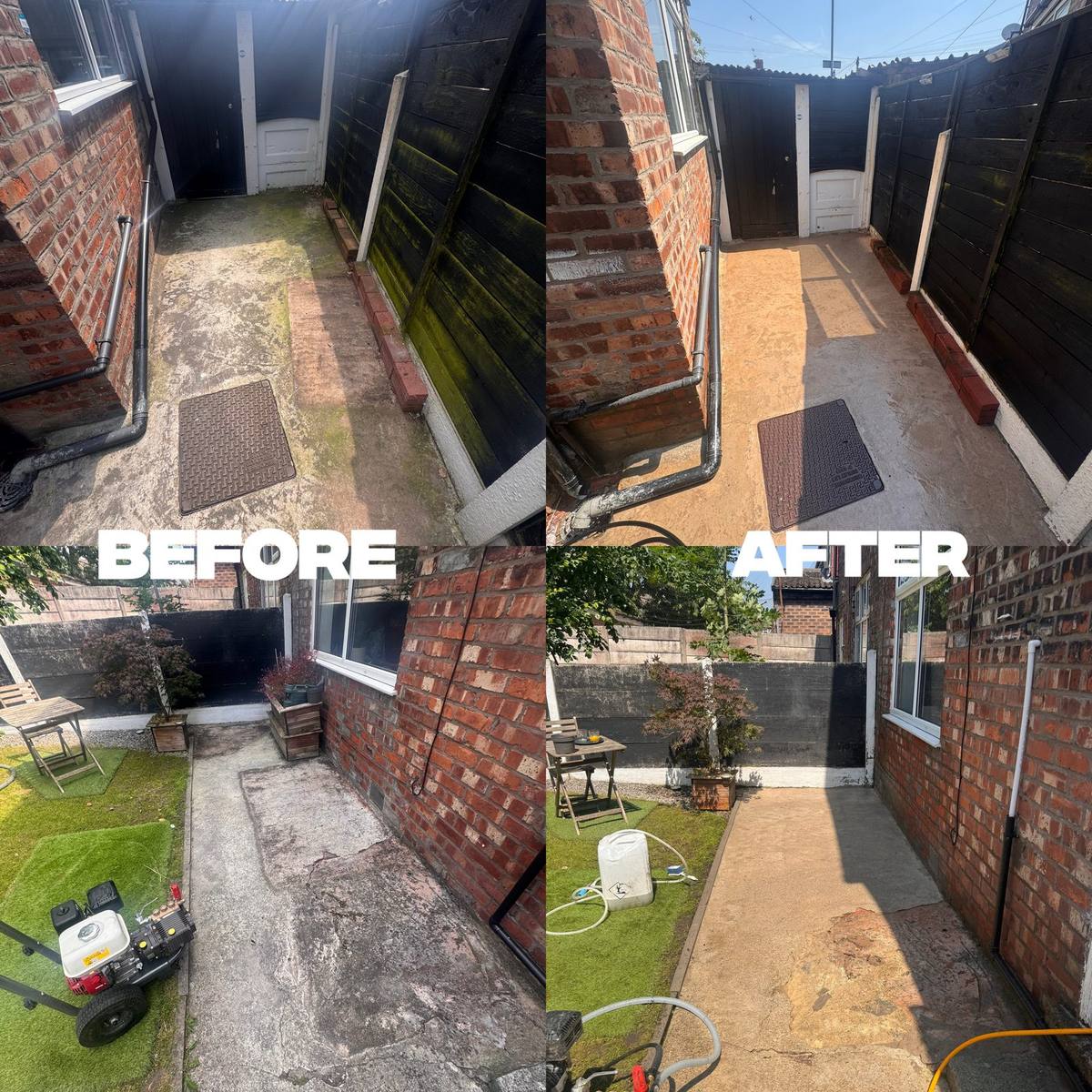
A typical path before and after professional cleaning — the difference in grip and appearance is immediate.
Quick answer: Communal walkway cleaning involves pressure washing or softwashing shared paths, entrances and access routes at residential or commercial properties to remove moss, algae, dirt and staining. It keeps surfaces safe underfoot, meets landlord maintenance obligations and is typically arranged by property managers, housing associations or letting agents.
What Is Communal Walkway Cleaning?
A communal walkway is any shared surface that forms part of an access route — the path from a car park to a building entrance, the paved area between two rows of flats, a covered fire exit route, or the footway running alongside a row of retail units. These are distinct from a private driveway or back garden patio because they're shared infrastructure. Nobody owns them in the way a homeowner owns their driveway, which means cleaning tends to fall to the building manager, the managing agent or the housing association rather than individual residents.
That shared ownership also means the scale of the job is usually much larger than a domestic clean. A single residential block might have 60 or 80 metres of shared path around it, across two or three different surface types. The access requirements are different too — works have to be coordinated around residents coming and going, trade vehicles need somewhere to park, and the job has to be done properly rather than just made to look presentable for a few weeks.
Communal walkway cleaning as a service is specifically built around those constraints. It's not the same discipline as turning up to jet-wash one family's back patio on a Saturday morning.
Who Typically Arranges This Service?
The most common clients are letting agents managing blocks of flats, housing associations with residential estates, private landlords who own HMOs or multiple properties on the same street, and residents' management companies acting on behalf of leaseholders. On the commercial side, site managers at retail parks, industrial units and office complexes also arrange communal walkway cleaning as part of their regular site maintenance — often alongside commercial pressure washing of car parks, bin stores and service yards.
Across Greater Manchester — Oldham, Rochdale, Bury, Bolton, Tameside, Stockport and the surrounding towns — the mix of older terraced properties converted into flats, purpose-built residential blocks and sprawling retail sites means there's a wide variety of communal surfaces that need attention. The North West's consistently damp weather makes the problem worse than it would be in drier parts of the country, which is why property managers here tend to find the issue coming up more regularly than they'd like.
For a broader picture of how exterior cleaning works across managed commercial and residential sites in this area, the guide on commercial exterior cleaning in Oldham covers the wider context in more detail.
What Does the Cleaning Process Actually Involve?
The job starts with an assessment of the surface condition — what it's made of, how badly soiled it is, whether there's active moss or algae growth, and whether any flags or joints are damaged. That assessment dictates the method. A concrete path with surface dirt and light biological growth needs a different approach from old sandstone flags with compacted moss and years of untreated algae. Getting the assessment wrong and just blasting everything at full pressure is how surfaces get damaged.
Where there's significant organic growth — moss, algae, lichen — the correct approach is to apply a biocide or suitable detergent and allow it to dwell for a period before any pressure is applied. Dwell time varies depending on product concentration and how embedded the growth is, but skipping this step and relying on pressure alone usually means you're removing the surface layer while leaving the root structure behind, which allows regrowth to happen faster. Pre-treatment takes more time but the results last significantly longer.
The pressure washing itself is done using a rotary surface cleaner for flat, open areas — it produces a more even clean than a lance and avoids the streaking you often see when someone has gone over a large area freehand. On textured surfaces, tight corners or areas around steps, a lance with an appropriate nozzle is used instead. Different surfaces — concrete, block paving, tarmac, imprinted concrete, natural stone flags — all behave differently under pressure, and the technique is adjusted accordingly. The whole area is then rinsed down cleanly.
Why Communal Walkways Get Dirtier Faster
High foot traffic is the obvious reason — more people using a surface means more dirt, grit and organic matter being ground in over time. But the more significant factor in the North West is the climate. Greater Manchester averages well over 800mm of rainfall a year, and the combination of frequent rain and relatively low sunlight hours means shared surfaces between buildings rarely get a chance to dry out properly. Moisture trapped on a shaded north-facing path between two blocks of flats is the ideal environment for algae and moss to establish and spread.
Shading from buildings compounds the problem considerably. A south-facing driveway at a detached house will dry out after rain and get enough UV exposure to slow biological growth. An access path running along the back of a residential block, shaded on both sides, may stay damp for days after rainfall. Over a season or two without cleaning, that kind of surface can go from slightly green to genuinely hazardous — compacted moss on wet flags has similar grip characteristics to ice.
Deferred maintenance makes everything worse. A light algae bloom treated once a year is manageable. The same surface left for three years has organic matter pressed deep into the pore structure of the stone or concrete, which takes longer to shift and may not come back to fully original colour regardless of what equipment is used. Being honest about that — some staining lightens significantly but may not vanish entirely — is more useful than promising results that depend on the surface's history.
Slip Hazard, Liability and Maintenance Obligations
A slippery communal walkway is not just a cosmetic problem. Landlords, housing associations and managing agents have a duty of care to keep shared areas in a reasonably safe condition for residents and visitors. Where that duty isn't met and someone is injured on a slippery surface, the legal and financial consequences can be significant. This isn't meant as a scare — it's simply the practical context that drives a lot of the enquiries about communal walkway cleaning from property managers who want to stay ahead of the issue rather than react to it.
Regular, documented cleaning forms part of a defensible maintenance record. If a communal walkway is cleaned once or twice a year, that work is logged, and the site is inspected between visits, that demonstrates a reasonable standard of care. A site that hasn't been cleaned in several years and has a documented history of complaints about the surface condition is in a much more exposed position. Whether cleaning is arranged as part of a broader maintenance schedule or as a one-off response to a specific concern, keeping records of what was done and when is straightforward and worth doing.
This is not legal advice — for specific obligations under a particular lease or management agreement, a solicitor or property management specialist is the right person to consult. But the practical picture is clear enough: a clean, well-maintained shared surface is safer than a neglected one, and documentation of that maintenance matters.
When to Call In a Professional Rather Than DIY
For a small domestic patio, a consumer pressure washer and a few hours is a reasonable approach — the area is manageable, it's your own property, and if the results are imperfect it mainly affects you. Communal walkway cleaning is a different proposition. The areas are larger, often significantly so, and consumer machines lack the flow rate and sustained pressure to clean large surfaces effectively or shift established algae colonies properly. Running a domestic pressure washer for four hours solid to cover a 150m² shared path is hard on the machine and unlikely to produce results that last.
There are also surface-specific risks. Old sandstone flags, worn concrete, loose-jointed block paving — these need lower operating pressure and careful technique, not just a powerful machine. Wrong settings on brittle or already-damaged surfaces can lift joints, fracture edges or etch the surface texture in a way that actually makes future biological growth worse. If the surface in question has loose pointing, cracked flags or compacted joints, it's worth getting a professional opinion before anything is blasted at it. The related guide on how to clean block paving properly covers some of the technique detail that applies equally to walkway surfaces.
If a communal path has significant moss or algae growth, pressure washing alone — without pre-treatment — will clean the surface visually but leave the biological root structure behind. Regrowth is then faster than it would have been on a properly treated surface. A biocide applied after cleaning, or as part of a two-stage process, makes a meaningful difference to how long the results last.
Health and safety around public access is another factor. Cleaning a surface while residents and visitors are using the site requires planning — working in sections, keeping clear egress routes, communicating with residents about wet surfaces. A professional contractor deals with this as routine. Someone trying to manage it alone, without the right signage or method, is adding unnecessary risk to an already complex job.
What to Do Before Booking a Communal Walkway Clean
Before making an enquiry, it helps to have a rough idea of the total area involved — even an approximate measurement or a count of roughly how many metres of walkway there are around the site. Surface type matters too: concrete flags, block paving, tarmac and natural stone all have different cleaning requirements and will affect the price. If there are obvious problem areas — heavy moss patches, cracked flags, areas where jointing has washed out — noting those separately is useful, as they may need specific treatment or may be flagged as pre-existing damage rather than something cleaning will fix.
For block paving surfaces specifically, it's worth considering whether re-sanding makes sense after cleaning. Cleaning removes the kiln-dried sand from the joints along with the dirt, and without re-sanding the joints are left open and vulnerable to weed growth and ant activity. Block paving re-sanding after cleaning extends the life of the work considerably. Pricing for block paving work typically starts from around £3.50/m² for a straightforward clean, £4.25/m² for a clean with chemical pre-treatment, and around £5.50/m² for a full restoration with re-sanding — re-sanding only on previously cleaned paving runs from approximately £2.00/m².
C&C Precision Precision Pressure Washing covers the whole of Greater Manchester and gives quotes based on photos sent over WhatsApp — no site visit is needed in most cases, and most enquiries get a price back the same day. It's the most efficient way to find out what a specific job would cost without committing to anything.
Frequently asked questions
How much does communal walkway cleaning cost in Greater Manchester?
Pricing depends on the total area, surface type and how badly soiled the walkway is. A straightforward concrete path at a small block of flats will cost less per square metre than heavy moss on old sandstone flags that need pre-treatment. The fastest way to get an accurate figure is to send a few photos over WhatsApp — we'll come back with a price the same day in most cases.
How often should communal walkways be cleaned?
For most properties in the North West, once a year is the practical minimum — ideally in late spring or autumn when organic growth is most active. High-traffic sites, shaded entrances or properties with known slip issues may benefit from twice-yearly visits. A one-off clean followed by a biocide treatment can also slow regrowth significantly and stretch the interval between cleans.
Will pressure washing damage old or loose block paving or flags?
It can, if the wrong equipment or technique is used. Old flags with worn joints or loose pointing need lower pressure and a wider fan nozzle rather than a concentrated lance. We assess the surface condition before starting and adjust accordingly — the goal is a clean walkway, not one that needs repairs straight afterwards.
Can you clean communal walkways at occupied residential blocks without disrupting residents?
Yes — we plan access routes and work around the site so residents can still get in and out safely while the job is in progress. Surfaces are obviously wet during cleaning and take a short time to dry, so we flag that clearly and work in sections where practical. It's something we deal with regularly on managed residential sites across Greater Manchester.
Need a price for a communal walkway clean in Greater Manchester?
Send a few photos of the walkway over WhatsApp and we'll come back to you with a straight price — no faff, no obligation.