Blocked gutters causing damp is one of those problems that tends to creep up slowly, then suddenly feel urgent when you notice a stain spreading across an internal wall. In the North West, where we get consistent rainfall across most of the year and damp air is just part of life in Greater Manchester, gutters work hard. When they stop working properly — whether that's a slow partial blockage or a gutter that's completely packed with organic debris — the consequences for the building below can be significant. The trouble is that many homeowners don't connect the dots until the damage is already well underway.
This guide covers how the problem actually develops, what to look for, what's typically causing the blockage, and what you can do about the wall staining and moisture damage that often remains even after the gutter is cleared. It's intended to help you understand what's happening to your property so you can deal with it properly rather than patch over the symptoms.
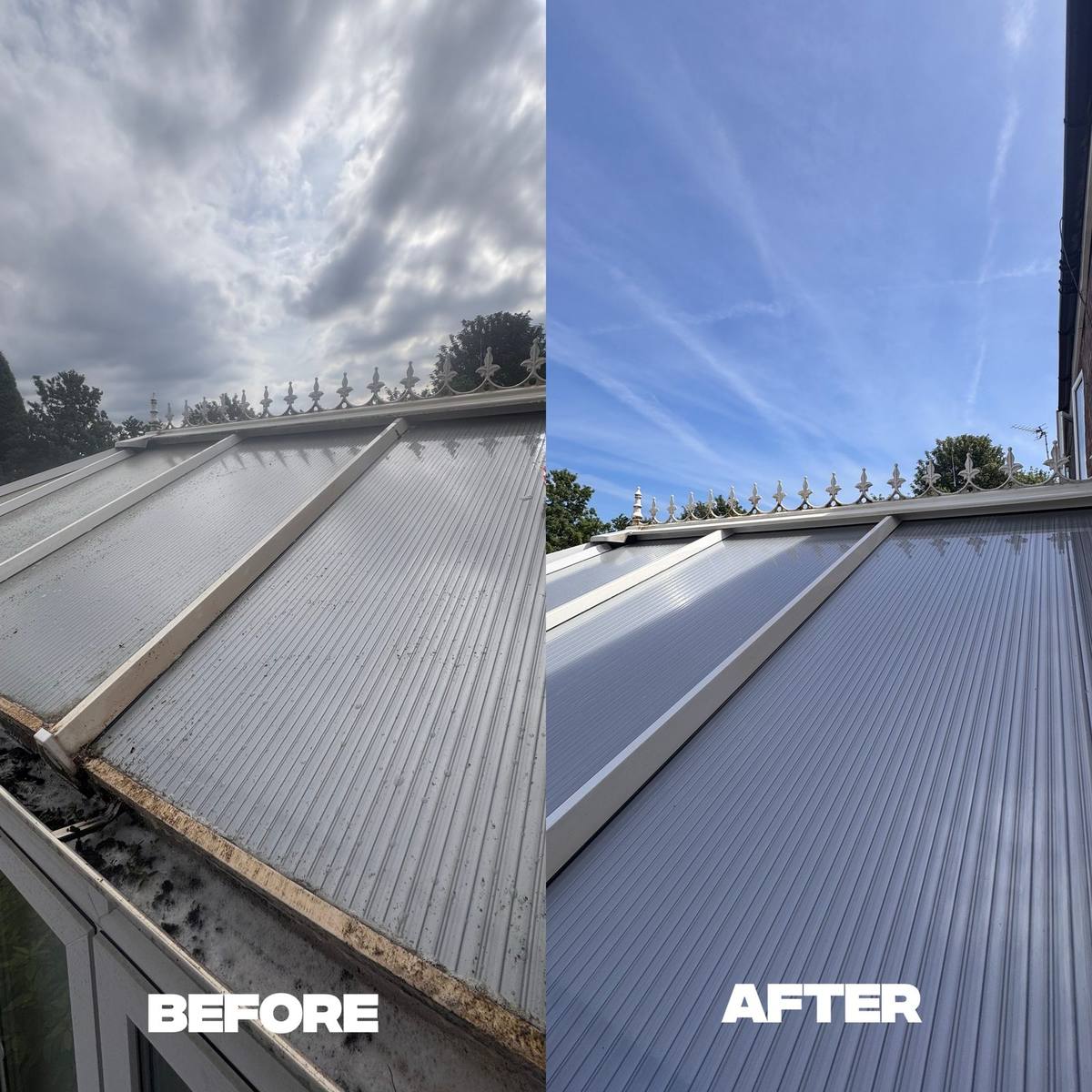
Moss and organic debris on a conservatory roof — exactly the kind of material that ends up blocking gutters and triggering damp problems.
Quick answer: Blocked gutters overflow and push water against fascias, soffits, and walls instead of directing it away from the property. Over time this saturates the masonry, leading to penetrating damp inside the home. Clearing gutters and cleaning the surfaces they've damaged is the most reliable fix.
How a Blocked Gutter Actually Causes Damp
A gutter's job is straightforward: catch the water coming off your roof and channel it safely to a downpipe and away from the building. When a blockage forms — even a partial one — water backs up and eventually spills over the front lip of the gutter. Rather than falling clear of the wall, that overflow runs directly down the external face of the building, often following the same path every time it rains. In a place like Greater Manchester, where you can expect rainfall on well over half the days in autumn and winter, that repeated soaking adds up fast.
Masonry is porous. Brick, render, and stone all absorb water to varying degrees, and under normal conditions they dry out between wet spells. When the same section of wall is getting soaked repeatedly from a gutter overflow directly above, it never gets the chance to fully dry. Saturation builds up over weeks and months, and once moisture has penetrated deeply enough into the wall, it can work its way through to the inner face. That's when it shows up as damp patches on internal plaster — typically on upper walls, below the roofline, or around window reveals on the upper floor.
It's worth distinguishing this from other forms of damp. Rising damp originates at ground level and moves upward through the base of the wall — it won't appear near the ceiling or just below the roofline. Condensation is an internal problem driven by humidity and cold surfaces, and it tends to show up on windows, external corners, and north-facing walls regardless of what's happening outside with rainfall. Blocked gutters causing damp produce a pattern that's linked to rainfall events and located on upper sections of wall, directly below the area where the gutter is overflowing.
The Warning Signs to Look For From Ground Level
You don't need to get on a ladder to spot most of the early indicators. The most obvious signs on the wall itself are vertical green or black streaks running down from the gutter line. Green streaking is typically algae — it thrives on damp masonry — while black streaking is usually caused by organic tannins and airborne pollution being washed down repeatedly in the overflow water. On rendered properties, these marks are often very clearly defined and follow the path water takes each time the gutter overflows.
If the property has light-coloured render or painted masonry, you may also notice a general darkening or discolouration on sections of wall that correspond with gutter joints or downpipe connection points, which are the most common spots for blockages to develop. Fascia boards that look darker than they should, or timber that's starting to look soft or stained, are another ground-level indicator that water has been sitting in or overflowing from the gutter for some time.
Inside the property, the signals often appear on the ceiling or upper walls of rooms that sit below the roofline — bedrooms on upper floors, hallway ceilings, or rooms in bungalows and single-storey extensions. Paint bubbling or lifting, plaster that feels soft or shows a tidemark, or wallpaper that's starting to peel away from the wall in a specific area are all worth taking seriously. If those internal signs worsen noticeably after a period of heavy rain, blocked gutters causing damp is a strong candidate.
What's Actually Blocking Your Gutters (And Where It Comes From)
The most common culprit in this part of the country is moss and algae debris from the roof. Our climate — cool, damp, and often overcast — is ideal for moss growth on roof tiles, and once moss takes hold it spreads steadily. As it grows and then breaks down, fragments and loose material wash off the roof surface during rainfall and collect in the gutters below. Over time this forms a dense, compacted layer that water simply can't pass through. It doesn't look like much when you see it, but a gutter packed with decomposed moss and algae sludge can completely prevent drainage even though the downpipe itself is clear.
Leaf debris is the other obvious contributor, particularly if there are mature trees nearby. Leaves on their own tend to be easier to clear, but when they combine with moss fragments and sit in a damp gutter through autumn and winter, they break down into a thick organic paste that's far harder to shift. Soil and seed material blown in from surrounding trees and rooftops add to this mix, and in older properties you sometimes find that decades of accumulation have left gutters that are effectively full.
The connection to roof cleaning and moss removal here is direct and practical. Treating roof moss with a professional softwash — using a low-pressure application of biocide — kills the moss at the root and allows it to gradually break down and wash away cleanly, rather than shedding in large chunks that collect in the gutters below. It doesn't eliminate the need to clear gutters, but it significantly reduces the volume of organic material that ends up in them.
The Damage That Builds Up While You're Not Looking
The frustrating thing about this kind of damage is how slowly it develops and how expensive it can become if it's left. The chain of events is fairly consistent: a blockage forms in the gutter, water starts to overflow instead of draining, the wall below gets repeatedly soaked, organic growth — algae, moss, lichen — takes hold on the damp masonry surface, and the situation accelerates from there. Algae and organic matter on a wall actively trap and retain moisture, making the wall harder to dry out even in warmer, drier periods.
From there, the damage can move in several directions depending on the construction of the building. In properties with cavity walls, persistent moisture on the outer leaf can eventually bridge the cavity and affect the inner leaf. Window frames and door frames set into the affected section of wall begin to deteriorate as the timber is repeatedly wetted. On rendered properties, moisture trapped behind the render can cause it to crack, bubble, or delaminate — at which point you're looking at a re-render rather than a clean.
Internal damage — replastering, redecorating, damp-proofing — costs considerably more than dealing with the external cause would have done early on. A situation that might have been resolved with a gutter clear and a softwash treatment on the wall can, if left for several years, require significant remedial work to both the exterior fabric of the building and the internal finishes. Blocked gutters causing damp is rarely a dramatic emergency when it starts, but it has a consistent record of becoming one.
Why Clearing the Gutter Is Only Half the Job
Once the blockage is removed and the gutter is draining properly again, the immediate problem is solved — but the wall below is in a worse state than it was before the blockage developed. The section of masonry that's been repeatedly soaked is likely to be carrying algae, organic staining, and potentially some surface degradation. Left in that condition, the algae and organic growth on the wall continue to retain moisture even in dry weather, slowing down the masonry's recovery and keeping it damp longer than it should be.
On rendered walls particularly, algae that's embedded into the surface will continue to grow and spread unless it's killed and removed. Pressure washing alone can strip the visible growth but it doesn't treat the underlying biology — algae and spores left in the pores of the render will regrow within a season, sometimes faster. Softwashing with a sodium hypochlorite solution dwell time of several minutes kills algae, bacteria, and other organic growth at the root. The wall can then dry out properly and, if needed, be inspected to assess whether the render itself has been compromised. For stained stone or brick, stone cleaning using the appropriate method for the substrate can remove much of the residual discolouration, though it's worth being honest that some deep staining lightens rather than disappears entirely.
After clearing a blocked gutter, photograph the wall below in direct light and again after the next rainfall. If you see water tracking down the same path as before, the overflow point may not be the blockage you cleared — gutters on older properties often have multiple low points or joint failures that aren't obvious until you run water through them deliberately.
When to Bring In a Professional Exterior Cleaning Company
Some situations are straightforward enough to manage yourself — a gutter with a handful of leaves and a wall that's showing a faint green tinge can often be dealt with fairly simply. But there are circumstances where professional help is the more practical option. If the render on your property is visibly green or streaked over a significant area, if the roofline has heavy moss growth that's been feeding debris into the gutters for several years, or if the wall looks damp or dark-stained after rainfall rather than drying out within a day or two, it's worth getting a proper assessment and treatment.
C&C Precision Pressure Washing handle exactly these situations across Greater Manchester — from render cleaning on residential properties where blocked gutters causing damp has left visible staining and algae growth, to full softwash treatments on rooflines and walls where moss and organic matter have been building up for years. Quotes are straightforward — send photos via WhatsApp and you'll get a clear answer on what's involved and what it's likely to cost, without needing a site visit in most cases.
For properties that haven't had any exterior cleaning in several years, or where there's been persistent water damage to external surfaces, it's also worth thinking about the sequence of work. Dealing with roof moss before cleaning walls means the walls won't be immediately recontaminated by debris washing down from above. The same logic applies to gutters — clear them first, then treat the wall surfaces below. Getting the order right makes the results last longer.
Practical Steps to Protect Your Home Going Forward
Checking your gutters twice a year — spring and autumn are the natural points — is enough to catch most problems before they develop into something serious. Spring checks pick up any material that's accumulated over winter, when leaves, moss fragments, and debris are most active. Autumn checks clear leaf fall before the wet season sets in properly. You don't need to do this yourself if you're not comfortable working at height; many gutter clearing services are quick and reasonably priced, and it's far cheaper than dealing with the damp damage that builds up when it's skipped year after year.
Roof moss is worth dealing with proactively rather than reactively. If you can see visible moss growth on your roof tiles from ground level, that's a sign it's already well established. A professional softwash biocide treatment will kill it over the following weeks and months as the dead moss gradually washes away. This reduces the volume of organic material reaching the gutters and significantly extends the time before significant regrowth occurs. It also helps the roof surface shed water more cleanly, which is part of what it's designed to do.
Photographing your external walls after heavy rain is a simple habit worth developing. You're looking for dark or wet-looking patches that appear in the same location after each downpour, vertical tracks of staining that seem to start at gutter level, or sections of wall that take noticeably longer to dry out than the areas around them. These patterns are much easier to spot in photographs taken in similar conditions, and they give you something concrete to act on rather than a vague sense that something might not be right. Exterior maintenance on a North West property isn't complicated — it just needs to be consistent.
Frequently asked questions
Can blocked gutters really cause damp inside the house?
Yes — and it's one of the most commonly misdiagnosed causes of penetrating damp. When a gutter overflows repeatedly, water runs directly down the external wall face. Given enough time and rainfall, that moisture saturates the masonry and works its way through to internal walls, often showing up as damp patches just below the roofline or around window reveals.
How do I tell if my damp is caused by blocked gutters rather than rising damp or condensation?
The location and timing are the biggest clues. Damp caused by blocked gutters typically appears on upper walls or just below the roofline and gets noticeably worse after heavy rain. Rising damp starts at floor level and stays there. Condensation tends to appear on cold surfaces like windows and external corners. If your damp patch appears or worsens after a downpour, start by looking at the gutters directly above it.
Does moss on the roof contribute to blocked gutters?
Directly, yes. Moss grows on roof tiles and gradually breaks down into loose fragments, which wash off during rain and collect in the gutters below. Over time this creates a thick, compacted blockage that water can't pass through. Treating roof moss with a professional softwash is one of the most effective ways to reduce the organic material that ends up in your gutters in the first place.
Can you clean the wall staining and algae left behind after a gutter blockage is fixed?
Yes. Once the blocked gutter is cleared, the external wall usually shows visible evidence — green algae, black streaks, and in some cases damp-damaged render. We use softwashing with a low-pressure sodium hypochlorite application to kill algae, bacteria, and organic growth on rendered walls, stone, and other exterior surfaces. It's a more thorough and longer-lasting solution than pressure washing alone on delicate surfaces like render.
Worried your gutters or exterior are causing damp problems?
Send a photo of your gutters, fascias, or affected walls on WhatsApp and we'll give you a straight answer and a fast quote.