If you've been searching for block paving restoration Manchester, you've probably reached the point where a quick sweep and a bucket of soapy water clearly isn't going to cut it. The paving looks dark, the joints are full of weeds, and there's a greyish-green film across the whole surface that seems to come back faster every year. That's not neglect on your part — it's just what happens to block paving in the North West, where the damp climate gives moss and algae exactly what they need to thrive.
This guide covers what proper restoration actually involves, what it costs, and how to keep the results looking good once the work's done. There's no upsell here — just a straight account of the process from someone who does this work every day across Greater Manchester.
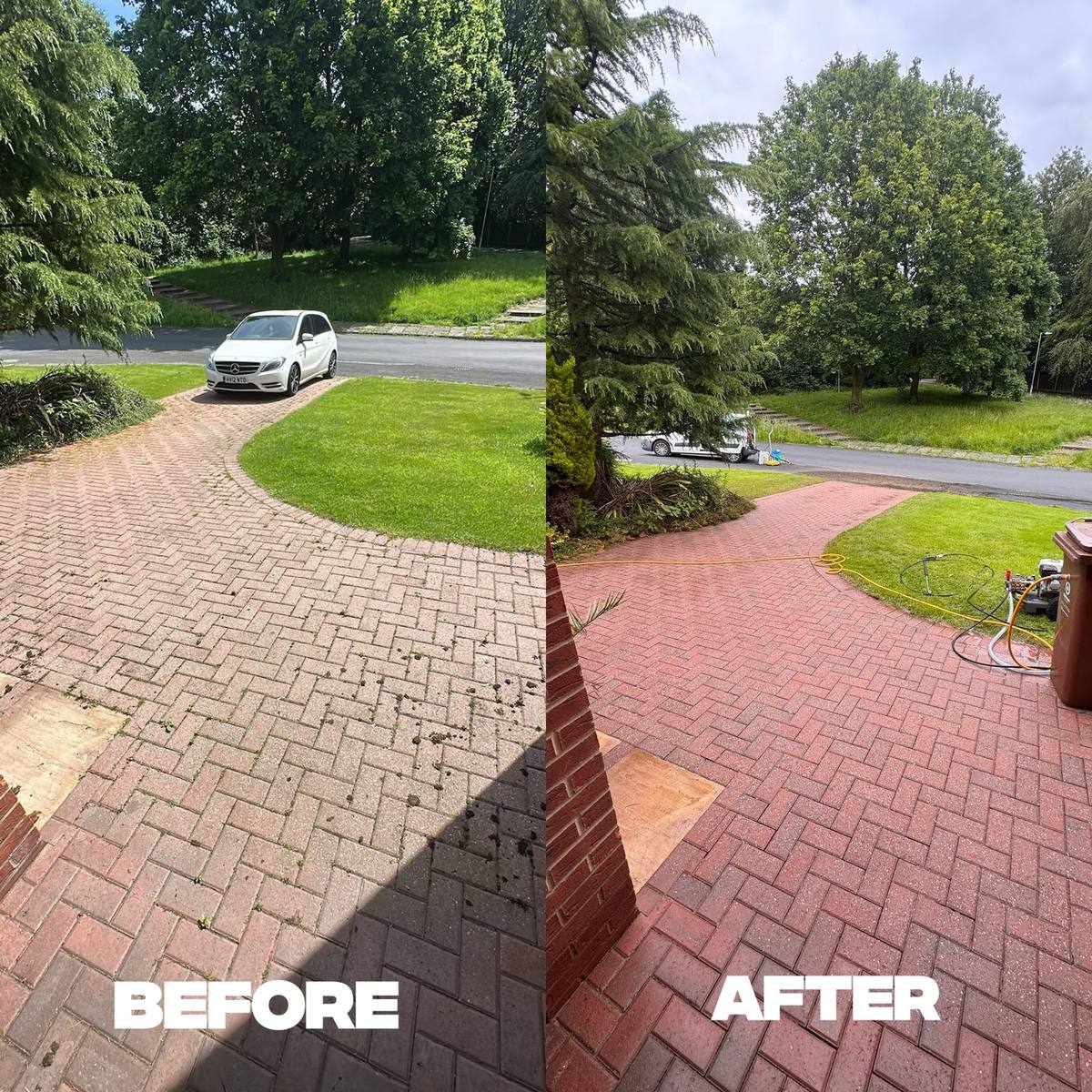
A red block paving driveway in Greater Manchester before and after a full restoration clean.
Quick answer: Block paving restoration in Manchester typically involves deep pressure washing to remove moss, weeds, and dirt, followed by re-sanding with kiln-dried sand to stabilise the joints. A full restoration brings faded, overgrown paving back to near-new condition and usually takes one day for an average driveway.
What Does Block Paving Restoration Actually Mean?
The word "restoration" gets used loosely, so it's worth being clear about what it covers. A basic pressure wash removes surface dirt, moss, and algae. That's useful, but it's only part of the picture. True block paving restoration typically includes a pre-treatment chemical to kill organic growth at the root, a deep high-pressure clean, hand-clearing of stubborn weeds along edges, and — critically — re-sanding the joints with kiln-dried sand once the surface has dried. Some customers also choose to have a sealer applied as a final stage.
Each of those stages does something the previous one can't. The chemical treatment kills the biology beneath the surface; the pressure wash removes what's already there; re-sanding stabilises the blocks and slows weed regrowth. Miss one stage and you compromise the result. It's also worth setting honest expectations: most surfaces come up dramatically, but heavily weathered concrete block will never look like it just left the factory. Old oil stains often lighten rather than disappear entirely. We'll always be upfront about what's realistic for a given surface before we start.
The Most Common Problems We See on Manchester Driveways
Greater Manchester gets around 800–900mm of rainfall a year, and that persistent dampness accelerates almost every problem block paving faces. Moss and algae are the most visible — surfaces can go from clean to noticeably green in a single wet autumn. The growth isn't just cosmetic; it makes paving slippery underfoot and, over time, the root systems work into the joints and loosen blocks.
Sand loss is the next big issue. Original jointing sand washes out gradually through rainfall and surface water run-off, leaving gaps that weeds exploit immediately. Once weeds establish in the joints, their roots push blocks apart and the surface starts to rock and shift. On older driveways, you sometimes see blocks that move underfoot — that's almost always a jointing problem rather than a sub-base failure, and it's fixable through cleaning and block paving re-sanding without any groundworks.
Oil staining is common on driveways used by older vehicles or where cars have been worked on, and it tends to penetrate into the block surface. Specialist degreasers help, and a hot wash makes a significant difference, but deep-set oil rarely disappears completely. Black spot — the tar-like marks left by certain algae — is similarly stubborn on some surfaces. There's a separate guide on how to remove black spots from patios if that's your specific problem.
How the Restoration Process Works, Step by Step
The job starts before the pressure washer comes out. A biocide or sodium hypochlorite solution is applied across the surface and left to dwell — typically 20 to 30 minutes depending on the product and the level of contamination. This dwell time matters because it kills the organic growth rather than just dislodging it. Skipping straight to the pressure wash means you're removing what's visible but leaving the biology in place, which is why growth comes back quickly after a purely mechanical clean.
Once the treatment has had time to work, the pressure washing begins. For block paving, a rotary surface cleaner attachment is usually more effective than a lance — it gives consistent coverage without the streak marks you get from a direct jet. Hot water machines clean more effectively than cold, particularly on oil and ingrained grime. After the main surface is done, the edges and any awkward corners are hand-cleared, and the whole area is blown down to remove debris from the joints before they dry.
After the surface has had time to dry — and in a Manchester summer that might mean returning the following day — kiln-dried sand is brushed into the joints and compacted with a plate compactor or by vibration. The sand is worked in until the joints are full and level with the block surface. If sealing has been agreed, that goes on last, over fully dried sand and paving. The result is a surface that's clean, stable, and properly jointed rather than just one that looks clean on the day.
Re-Sanding: Why It's Not Optional
This is the part of block paving restoration that customers sometimes want to skip to save money, and it's worth explaining honestly why that's a false economy. Pressure washing — even done carefully — removes a significant amount of the existing jointing sand. It has to, because that sand is full of weed seeds, organic matter, and the remnants of whatever was growing in the joints. Once it's gone, the blocks are essentially floating. On a driveway that takes vehicle weight, loose blocks flex under load, and that movement gradually works the whole surface apart.
Without fresh jointing sand, weeds also return within weeks rather than months. Sand-filled joints leave very little space for seeds to establish; open joints are effectively a prepared seedbed. Kiln-dried sand is used rather than building sand because it's dry enough to flow into the joints freely and doesn't compact into a damp mass. The full details of why this step matters — and what the process looks like in practice — are covered in the guide on re-sanding block paving after cleaning.
If you've had your block paving cleaned before and the weeds were back within a few weeks, the most likely reason is that the joints weren't re-sanded afterwards. It's not always the cleaner's fault — sometimes customers decline it to keep costs down — but it's the reason the results don't last.
What Does Block Paving Restoration Cost in Manchester?
Pricing for block paving work in Greater Manchester varies depending on the size of the area, the severity of the contamination, access to the site, and whether re-sanding is included. As a rough guide, a straightforward block paving clean starts from around £3.50 per square metre. Add a chemical pre-treatment and that moves to around £4.25 per square metre. A full restoration including re-sanding typically works out at £5.50 per square metre. Re-sanding alone, if the surface has recently been cleaned, is around £2.00 per square metre.
To put that into practical terms: a modest single-car driveway of around 30 square metres would be roughly £105–£165 for cleaning, or around £165 for a full restoration with re-sanding. A standard two-car driveway at 50–60 square metres runs from around £175 for a basic clean up to £330 for the full job. Larger driveways over 80 square metres will obviously cost more, but the per-square-metre rate can come down slightly on bigger areas. These are honest ballpark figures — the exact quote depends on what we see.
The fastest way to get an accurate price is to send a couple of photos over WhatsApp. You don't need to measure the driveway yourself — a photo from the street and one from the top of the drive gives enough information to quote accurately most of the time. Quotes are free and usually come back the same day. If you're also curious about driveway cleaning costs more broadly, the guide on driveway cleaning costs in Oldham has more detail.
When Should You Call a Professional Instead of DIYing It?
A confident homeowner with a decent domestic pressure washer can manage a light clean on a relatively clean driveway — if the paving has been maintained regularly, there's no heavy moss, and re-sanding isn't needed. It's honest to say that. A 1,400 PSI machine with a surface cleaner attachment and some patience will shift surface dirt and light algae, and for small areas that's a reasonable option.
The case for calling someone in gets stronger when the surface is heavily contaminated with moss and algae, when there are established weeds throughout the joints, when the area is large, or when re-sanding is needed — because that requires a plate compactor and the right grade of sand, neither of which most households have. Oil staining and black spot also benefit significantly from hot water and commercial-grade chemicals that aren't available at hire shops. If you're thinking about sealing afterwards, that definitely warrants professional application, as an uneven or poorly prepared seal can look worse than no seal at all.
For commercial work — car parks, retail areas, housing association properties — the scale and the need for consistent results make professional work the only practical route. There's more on that side of things in the guide on commercial pressure washing for landlords. C&C Precision covers this kind of work across Greater Manchester alongside domestic driveways.
How to Keep Block Paving Looking Good After Restoration
The single most useful thing you can do after a full block paving restoration Manchester is to spot-treat weeds as soon as they appear rather than waiting until they're established. A few minutes with a hand weeder or a targeted weedkiller in spring pays back enormously compared to leaving things until the joints are full again. Weeds in freshly re-sanded joints are much easier to remove than weeds that have had a season to root into open sand.
Check your gutters and downpipes as well. A blocked gutter that pours water over the edge of the house and onto the driveway will wash sand out of the joints faster than anything else, and it concentrates moisture in one area which accelerates moss growth. Keeping water running where it's supposed to run makes a real difference to how long the restoration lasts.
For most domestic driveways, an annual or biennial professional clean is enough to keep things in good order once the initial restoration has been done. Whether to seal the paving is a separate decision. A quality sealer does slow down weed growth and makes the surface easier to clean, but it needs to be reapplied every few years, and a worn seal can look patchy. It's worth asking about when you get a quote, but it's not essential — plenty of driveways look well-maintained for years without it.
Frequently asked questions
How long does block paving restoration take in Manchester?
For an average domestic driveway — say, two cars wide — a full restoration including cleaning and re-sanding typically takes between four and seven hours in one visit. Larger driveways or heavily contaminated surfaces may need a second day. We'll always give you a realistic timescale when we quote.
Does block paving restoration include re-sanding as standard?
Not always — it depends on the contractor and what you've agreed. At C&C Precision, we discuss re-sanding with every customer because pressure washing removes the existing jointing sand. Skipping re-sanding leaves the blocks unstable and speeds up weed regrowth, so we strongly recommend including it.
Can block paving be restored if it's been neglected for years?
In most cases, yes. Even paving that's heavily mossy, weed-ridden, or stained usually responds well to a professional deep clean. The exception is where blocks are cracked, sunken, or the sub-base has failed — that's a groundworks job, not a cleaning job, and we'll tell you honestly if that's what we find.
Do you cover my area for block paving restoration?
We're based in Oldham and cover Greater Manchester including Rochdale, Bury, Bolton, Manchester city, Tameside, Stockport, and surrounding towns. If you're not sure whether we reach you, just drop us a message on WhatsApp with your postcode and a couple of photos of the driveway.
Want to Know What Your Driveway Would Cost to Restore?
Send a couple of photos over WhatsApp and we'll come back to you with a straight price — no fuss, no sales pitch.