If you've been putting off getting your driveway sorted, you're not alone. Block paving cleaning in Oldham is one of the most common jobs we get called out for across Greater Manchester, and most of the time the paving underneath is in better shape than it looks. Years of moss, algae, and general grime can make a driveway look beyond saving when in reality a proper clean makes a significant difference. This guide covers everything you need to know — what causes the deterioration, how the cleaning process works, what it costs, and how to keep on top of it afterwards.
We've also tried to be straight with you about the things that don't always come out perfectly. Some deep oil stains lighten rather than disappear entirely. Older blocks that have faded over many years won't come back to their original colour through cleaning alone. That's just the reality of working with exterior surfaces in a wet Northern climate, and we'd rather tell you that upfront than oversell what a pressure wash can do.
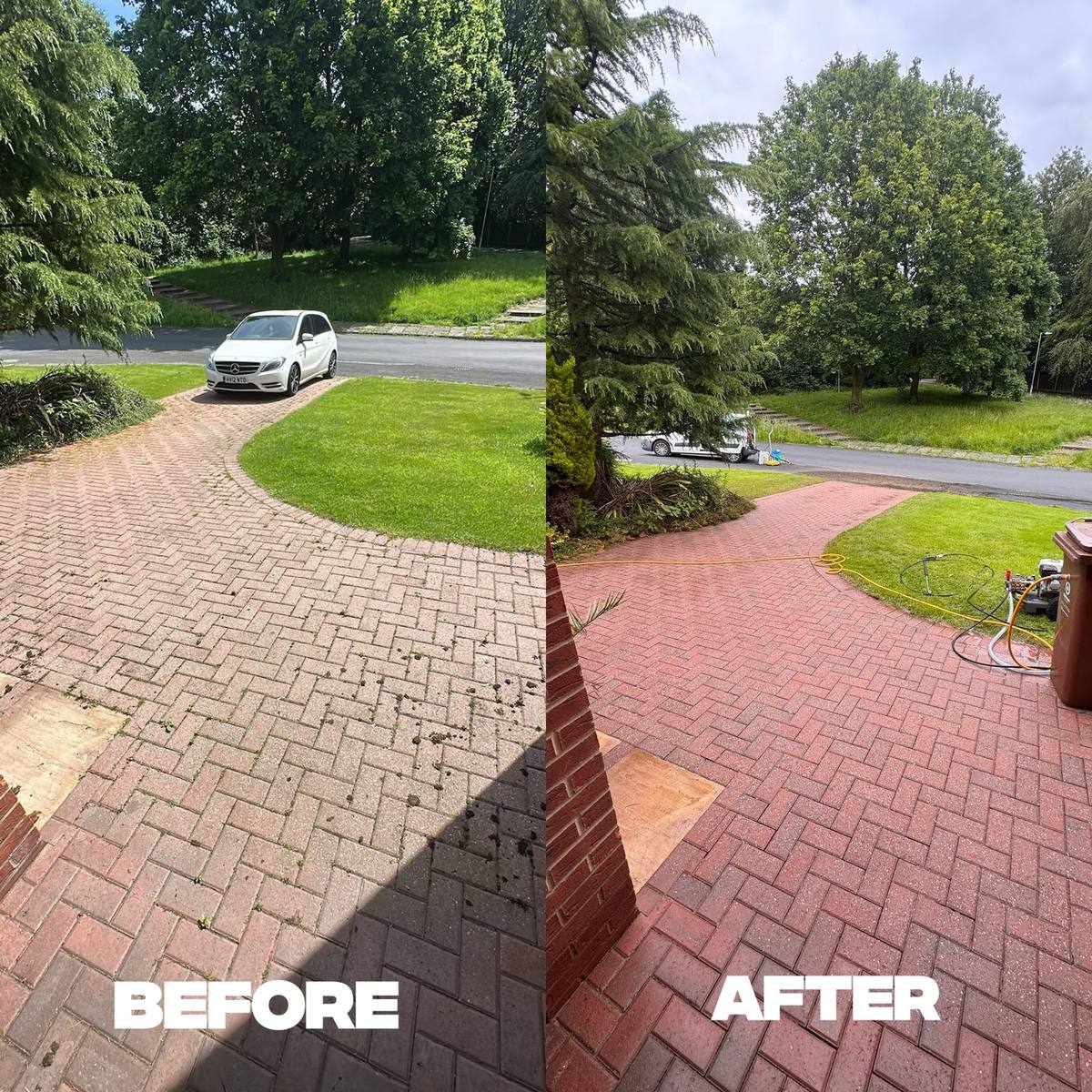
A red block paving driveway in Oldham — before and after cleaning by C&C Precision.
Quick answer: Block paving cleaning in Oldham involves pre-treating the surface with a biocide or detergent, pressure washing with a rotary surface cleaner to lift dirt, moss, and weeds, then re-sanding the joints with kiln-dried sand to stabilise the blocks. Most driveways take two to four hours and look like new the same day.
Why Block Paving Gets Into Such a State
Greater Manchester is not a forgiving environment for block paving. We get significant rainfall spread across the whole year, plenty of overcast days that keep surfaces damp for long stretches, and no shortage of shade from neighbouring houses, fences, and trees. That combination is exactly what moss, algae, and lichen need to establish themselves. Once organic growth takes hold in the joints and across the surface, it retains even more moisture, which accelerates the cycle further.
Clay and concrete blocks are both porous to varying degrees, which means they absorb water rather than shedding it cleanly. Leaves and other debris settle into the joints, decompose, and create a layer of organic matter that acts as a growing medium for weeds. In shadier spots — a north-facing driveway in Oldham or a side passage between terraces, for example — you can go from a freshly cleaned surface to a visibly green one within a single winter if no treatment has been applied.
None of this means there's anything wrong with your paving or that it was laid badly. It's just what happens to exterior surfaces in this part of the country. The good news is that most block paving responds well to a proper clean, even after years of neglect, and the results tend to be more dramatic than customers expect.
The Cleaning Process Step by Step
A thorough block paving clean isn't just a case of pointing a pressure washer at the floor. The process starts with a pre-treatment — either an alkaline detergent or a biocide depending on the type and extent of the organic growth. This is applied to the surface and left to dwell, usually for around fifteen to thirty minutes. The dwell time matters because it breaks down the biological matter and loosens the bond between the growth and the block surface, making the subsequent pressure washing far more effective and reducing how hard the machine has to work.
The main cleaning is done with a rotary surface cleaner rather than a lance alone. A rotary head sits close to the surface and spins two nozzles in a controlled arc, which means the water pressure is applied evenly across the whole area. The result is a consistent clean without the streaking or tiger-striping you get when someone sweeps a lance back and forth across blocks. It's also gentler on the surface because the pressure is distributed rather than focused on a single point. After the rotary work, a lance is used along edges, against walls, and in any corners the head couldn't reach.
The job finishes with a thorough rinse to clear away the loosened debris and any remaining detergent or biocide residue. On heavily contaminated driveways, it's sometimes worth a second pass with the rotary cleaner after the rinse to catch anything the first run lifted but didn't fully clear. The whole process — pre-treat, dwell, rotary clean, edge work, rinse — is what separates a proper result from a surface that looks clean on the day but greens up again within a few months.
What Happens to the Sand in the Joints?
This is something a lot of customers don't think about until after the clean, so it's worth explaining before the work starts. Pressure washing block paving will always displace some of the sand from the joints — it's unavoidable at the pressures needed to actually clean the surface. On a driveway that hasn't been touched in several years, the joint sand is often already degraded, compacted, or partially washed out from previous rainfall, so there may not be much left to displace in the first place.
The joints aren't just there for appearance. They hold the blocks in place, distribute load between them, and prevent lateral movement. If joints are left empty or poorly filled after a clean, the blocks can rock slightly underfoot or under vehicle weight, and weeds find it considerably easier to establish. Re-sanding is the solution, and when it's done properly it makes a real difference to how long the clean lasts.
Kiln-dried sand is brushed into the joints in passes, working it in until the gaps are full and the surface is level. The sand needs to stay dry during this process, which is why we keep a close eye on the forecast. Once it's in, we ask that the driveway is kept off for around 24 hours where possible — foot traffic and vehicle weight can disturb the sand before it has had time to consolidate. Kiln-dried sand also tends to resist weed germination better than the coarser, moister alternatives, which is another reason it's the right material for the job. For more detail on the full restoration process, see our block paving re-sanding page.
How Long Does It Take and What Does It Cost?
Most domestic driveways in Oldham and across Greater Manchester take between two and four hours to clean properly, including pre-treatment, dwell time, rotary cleaning, edge work, and rinse. A small front driveway might be closer to ninety minutes; a large double driveway that hasn't been touched in a long time could run to five or six hours. Condition matters as much as size — heavily neglected block paving with deep-set moss and compacted debris takes longer to treat and clean than paving that gets done every couple of years.
For pricing, block paving cleaning starts from around £3.50 per square metre for a straightforward clean. If the surface needs a chemical pre-treatment to deal with significant biological growth, that's typically £4.25 per square metre. A full restoration including re-sanding joints with kiln-dried sand is around £5.50 per square metre, and re-sanding alone — if the paving has already been cleaned recently — is around £2.00 per square metre. A typical domestic driveway of 40–60 square metres usually works out somewhere between £140 and £330 depending on what's needed.
Those figures are honest ballparks rather than firm quotes, because the condition of the surface makes a significant difference to the time involved. The best way to get an accurate price is to send a couple of photos over WhatsApp — a shot of the full driveway and one closer up so we can see the surface condition. Most quotes come back within a few hours, and there's no obligation.
Before booking any block paving work, take a photo of the joints in a shaded corner of the driveway. If you can't see any sand at all — just gaps or compacted organic matter — re-sanding after cleaning is worth budgeting for. Empty joints let weeds back in quickly and are one of the main reasons a clean doesn't last as long as it should.
Block Paving Cleaning vs Sealing — Do You Need Both?
Cleaning and sealing are two separate things, and it's worth understanding the difference before deciding what you want done. Cleaning removes the biological growth, dirt, and staining from the surface. Sealing goes on afterwards and creates a barrier that slows down future contamination, makes the surface easier to clean, and in some cases enhances the colour of the blocks. Cleaning is always worth doing on its own. Sealing is optional, but when it's applied correctly to the right surface it does extend the results and protect the investment of a proper clean.
There are different types of sealant. A wet-look or gloss sealant darkens and saturates the colour of the blocks, which some people like the look of and others don't. A matt or natural finish sealant is less visible and more understated. Both need to be applied to a completely clean, dry surface — if any moisture or biological residue is trapped underneath, the sealant can lift, cloud, or peel within months. Badly applied sealant genuinely looks worse than no sealant at all, which is why it matters who does it and how carefully the surface is prepared.
It's also worth being honest about longevity. Sealant in a North West climate, where the surface is frequently wet and sees regular freeze-thaw cycles through winter, doesn't last indefinitely. Most good sealants on block paving will last three to five years before they need redoing, though that varies by traffic levels and surface exposure. If you're on the fence about it, the clean alone is a perfectly reasonable choice — you can always seal at a later date once you've seen how the surface responds.
When to Call a Professional Rather Than DIY
Hiring a pressure washer for a weekend to do the driveway yourself is tempting, and for some jobs it's a reasonable approach. But block paving is one of the surfaces where DIY pressure washing most often causes problems. Consumer-grade and mid-range hire machines frequently come with a pencil-jet lance as the primary attachment. Used too close to the surface — which is easy to do without experience — a pencil jet will scar the face of the blocks and blast out jointing sand unevenly, leaving some joints completely empty while others remain partly filled. Uneven joints are harder to re-sand properly, and scarred block surfaces can't be reversed.
The other common issue is moss management. Pressure washing without a pre-treatment biocide removes the visible growth but leaves the spores in place. Those spores can spread during cleaning as the water carries them across the surface, and regrowth can come back faster than if the surface had been treated first. A hired machine also won't have a rotary surface cleaner in most cases, which means the finish is less consistent and more effort for a comparable result.
The cost of hiring a machine for a day, buying detergents, and spending a full day on the job often comes surprisingly close to the cost of having it done professionally — particularly when you account for the re-sanding that's needed afterwards. If you're dealing with a small, lightly soiled surface, DIY can be fine. For a full driveway with established moss and years of build-up, it's usually worth getting someone in who does this every day. C&C Precision covers Oldham and the wider Greater Manchester area, and you can see the kind of results we get on our reviews page.
How to Keep Block Paving Looking Good Between Cleans
Regular sweeping is the single most effective thing you can do between professional cleans. Leaves and debris left sitting on block paving break down and feed the moss and algae that discolour the surface. A quick sweep every couple of weeks during autumn makes a more noticeable difference than most people expect. If you spot moss or green algae starting to establish — particularly in shaded joints or along edges — treating it early with a diluted biocide solution is far easier than dealing with it once it's fully established across the surface.
It's also worth checking your gutters and downpipes if part of your driveway gets noticeably wetter than the rest. Blocked gutters that overflow onto the same section of paving consistently, or downpipes that discharge directly onto the block surface, create a persistent damp patch that grows biological matter far faster than the rest of the driveway. Fixing the source of the excess water makes the cleaning results last longer.
In Greater Manchester's climate, most block paving benefits from a professional clean every one to two years. Heavily shaded driveways, or ones under trees, will likely need attention more frequently. Driveways in more open, sunny positions can sometimes go a little longer. Rather than waiting until it's visibly green and overgrown, cleaning it before it gets that far is cheaper and quicker — and the results are more consistent. If you've had block paving cleaning done recently and just need the joints sorted, our re-sanding service can be booked on its own. Or if your driveway is a different surface entirely, take a look at our driveway cleaning page for more information on what's involved.
Frequently asked questions
How much does block paving cleaning cost in Oldham?
Most residential block paving driveways in Oldham cost between £80 and £250 depending on size and condition. Re-sanding joints adds to the price but is often recommended after a deep clean. Send us a couple of photos on WhatsApp and we'll give you an accurate figure without any guesswork.
Will pressure washing damage my block paving?
Done correctly with a rotary surface cleaner and the right pressure settings, professional cleaning won't damage sound block paving. The risk comes from using a pencil-jet lance too close to the surface, which can scar blocks and blast out all the jointing sand unevenly. That's one of the main reasons it's worth using someone who does this every day.
Do I need to be home when the work is carried out?
Not necessarily — we just need access to the area being cleaned and a nearby outdoor tap. Many customers are at work when we arrive. We'll let you know when we're on our way and send photos when the job's done, so you can see the result even if you're out.
How long after cleaning can I use my driveway again?
You can generally drive and walk on a freshly cleaned driveway within an hour or two. If we've re-sanded the joints with kiln-dried sand, we ask that you keep off it for around 24 hours where possible to let the sand settle properly before it gets disturbed.
Want a price for your block paving in Oldham?
Send a couple of photos on WhatsApp and we'll come back to you with a fast, no-obligation price — usually the same day.